

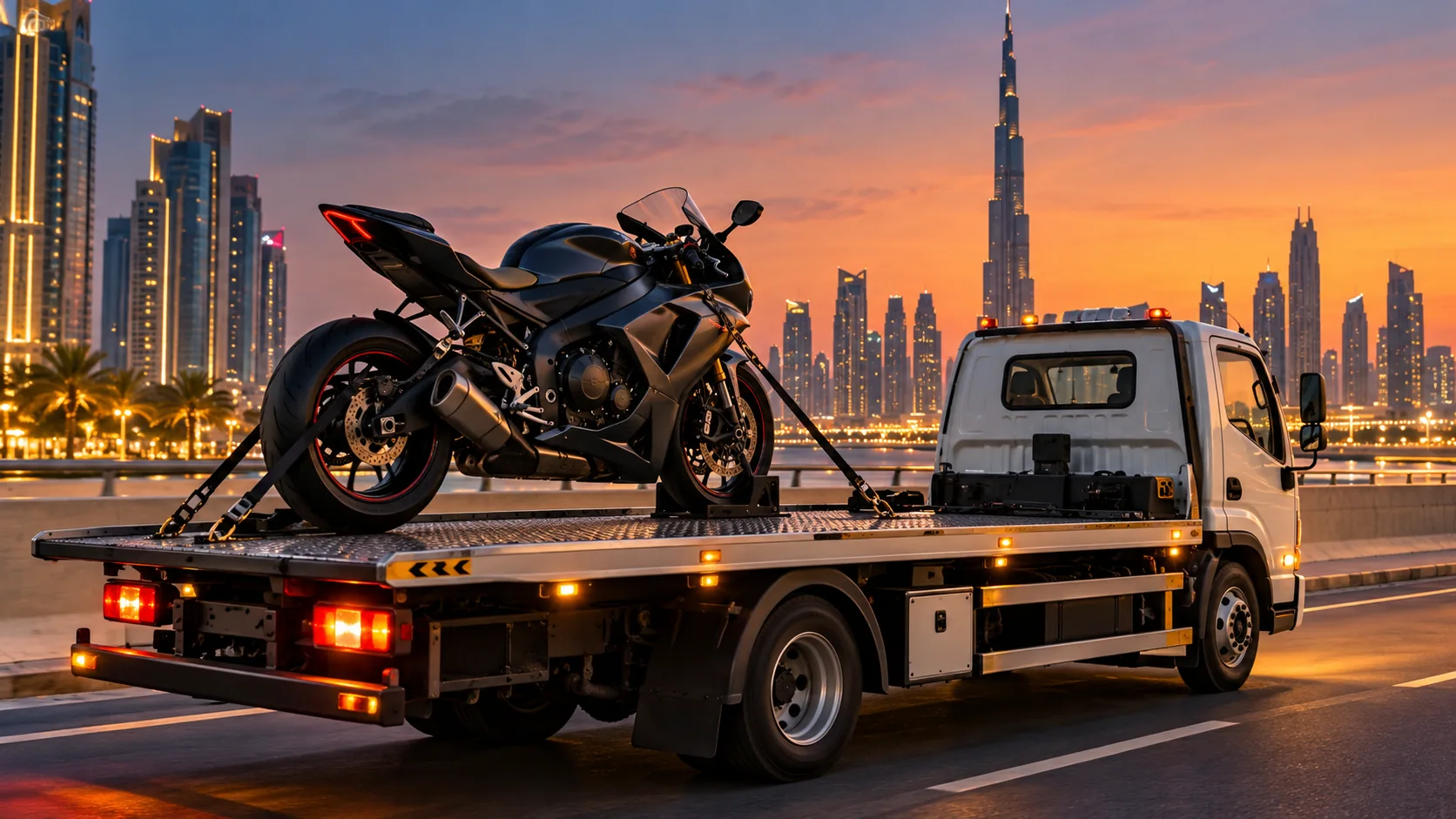
A motorcycle that cannot be ridden safely creates a different transport problem from a disabled car. It must remain upright or be handled according to its actual condition, reach a suitable loading point and arrive at a receiver who is ready for it. Its small footprint can be misleading: two wheels, exposed bodywork, handlebars, mirrors, luggage and delicate attachment points all affect how a collection should be planned. A rider searching for motorcycle towing in Dubai needs to know what to say to the provider, what to check before the bike is moved and what happens at handover.
Dubai Car Recovery lists motorcycle transport among its services. Availability, equipment fit, access, securing method and quote must be confirmed for the particular bike and pickup. Call +971 50 126 3137, use WhatsApp at +971501263137, or email dubaicarrecoverhelp@gmail.com. Give the motorcycle make and model, approximate weight if known, current mobility, damage, location, pickup access and destination. This guide explains why those details matter. It does not promise a specific truck, arrival time, price, repair, or result before the team assesses the request.
1. First decide whether the bike should be ridden
A motorcycle may still start and move while its tyres, controls or frame are unsafe. “It runs” is therefore not enough to rule out transport. A rider may have a flat tyre, broken control, collision damage, leaking fluid, unstable steering or an unexplained noise. The decision to ride should follow the actual condition and a qualified assessment, not the inconvenience of arranging a collection. If the rider is injured or in immediate danger, appropriate emergency help comes before ordinary vehicle transport.
The rider can describe what happened without diagnosing the fault. “The front tyre lost air and the steering now feels abnormal” is useful. “The wheel bearing is broken” may be a guess unless a professional has inspected it. Report whether the bike is upright, whether it rolls and steers, whether the brakes release and whether any parts are loose. These facts help a transport team assess how it might load the bike.
A short ride is not automatically low risk. A motorcycle depends on tyre grip, balance and responsive controls throughout the journey. A defect that might appear minor while stationary can become serious when turning or braking. The destination's distance does not establish that the trip is safe.
Transport is a practical option when the bike is not fit to ride, when a buyer or seller needs a planned move, or when a workshop asks for delivery. The method must suit the machine and site. The rider's first job is to state the condition honestly and choose a safe, accessible pickup point if one is already available.
2. Motorcycle towing is a transport decision, not a repair diagnosis
The word “towing” describes the customer's need to move the motorcycle, but it does not explain the mechanical problem or the equipment required. A bike with a discharged battery may roll normally; a bike with a bent front end may not steer; a bike after a fall may be lying on its side. Each presents a different collection task. The provider should ask about the actual state before confirming suitability.
Likewise, a truck arriving does not mean the bike has been declared repairable. A receiving workshop may need to inspect tyres, controls, frame, suspension, electrics or fluid leaks. The transport team can carry observed facts through the handover but should not promise a technical outcome that belongs to a motorcycle specialist.
The customer should distinguish three decisions: whether the motorcycle needs transport, whether the proposed provider can safely handle this machine at this pickup, and whether the receiving location can assess or accept it. Solving only the middle question may leave the rider with a bike at a closed gate.
For planned transport, the bike may be mechanically sound but not intended to be ridden between the two locations. A buyer may want collection from a seller; an owner may be moving it between storage and workshop. In those cases, the same access and custody details matter even without a breakdown. The transport request should state the purpose so the handover can be organized appropriately.
3. The information that makes a quote meaningful
Start with the bike's make, model and year if known. Give an approximate weight when the manufacturer specification or documentation is available, but do not invent one. Mention sidecars, large panniers, top boxes, custom bodywork or other modifications that change width, height or securing access. A photo from a safe angle can help, but it is an aid to assessment rather than proof of compatibility.
State the motorcycle's current condition. Can it stand upright? Is the side stand intact? Do both wheels roll? Is the steering free? Are the front brake, rear brake or transmission locked? Is there collision damage, a loose fairing or a fluid leak? If the rider does not know, say so. Unknowns are part of the planning information.
Then provide the pickup and destination as real access points. “Apartment in Business Bay” does not tell the team the basement level, ramp clearance or gate. “Garage in Al Quoz” does not tell it the receiving entrance or closing time. Share the precise bay or roadside position and a contact who can admit the vehicle at both ends.
Finally, ask what the quote covers and what might change it. Collection, loading, securing, transport and unloading should be understood as an agreed scope. If the bike cannot roll or the site has a height limit, the method may differ from an ordinary pickup. A useful quote follows the facts, not a one-line “bike tow” request that hides constraints.
4. Location sharing for a two-wheeled vehicle
A pin can identify a general area but may not indicate the accessible side of a road, the correct tower entrance or the parking level. Pair the pin with a short written route: street or facility name, level, bay, gate and a landmark. If the bike is near a road, identify the travel direction and a safe stopping point without asking the rider to enter traffic to read a sign.
Some riders move the motorcycle a short distance after a failure. If the bike has been pushed to a safer location, report the current position, not the place where the fault first occurred. If it cannot roll, say that before dispatch. A transport team may need to approach differently when the motorcycle cannot be pushed to a loading point.
At a building, ask security whether a recovery vehicle can enter and which gate it must use. A low basement may not admit the vehicle used for transport. The team may need a safe meeting point at ground level, but the rider should not push an unstable or damaged bike up a steep ramp without appropriate help. The access plan must be realistic for the bike's condition.
Good location data makes the first visit productive. It also protects the rider from treating a map pin as a safety plan. The last metres—stairs, curb, ramp, tight turns and controlled doors—are where a motorcycle pickup can become unexpectedly difficult.
5. Upright, leaning or fallen: describe the bike as found
A motorcycle standing securely on its side stand is different from one held upright by a person, wedged against a barrier or lying on its side. Tell the provider which condition applies. Do not lift a fallen bike alone if doing so risks injury or could worsen damage. A qualified on-site team can assess how to recover and stabilize it before loading.
A bike may tip because its stand is broken or the ground is soft. A transport plan must account for that before the rider lets go. If the motorcycle is supported temporarily, explain by what. A photograph can help if taken safely and without staging the bike into a less stable position.
After a fall, note visible damage to levers, mirrors, handlebar, foot controls and bodywork. A bike that starts may still have damaged controls or fluid leakage. The receiving workshop should know the fall history. The transport team needs the same facts to avoid using a damaged part as a handhold or securing point.
The customer should not try to make the bike look “ready for collection” by forcing it upright or moving it into traffic. The honest state is more useful than a tidier photograph. The team can confirm whether its current equipment and staffing suit the actual recovery task.
6. Rolling condition is more specific than engine condition
A motorcycle can fail to start but roll freely. It can also start but be impossible to roll because a wheel, brake or drivetrain is damaged. Tell the provider whether each wheel rotates and whether the bike can be steered, if this has been observed safely. Do not test it by pushing through traffic or down a slope. If mobility is uncertain, state that uncertainty.
The loading method may depend on whether the bike can be guided up a ramp or must be moved another way. The team should decide that from the bike, site and equipment. A customer should not assume a standard loading sequence works for a bike with a locked front wheel or damaged forks. It may require a different approach or a different provider.
A tyre that is merely low and a wheel that is mechanically stuck are not the same. Describe the visible condition and any event that preceded it. If the motorcycle struck a curb, fell or was involved in a collision, include that history. It gives context without claiming a diagnosis.
At the receiving end, tell the workshop how the bike moved during loading. If a wheel had to be supported or would not roll, that fact should travel with the bike. A transport handover is more complete when the recipient understands the handling constraint, not just the customer's original complaint.
7. Why secure transport has to fit the actual bike
Motorcycles vary in shape and weight. A small commuter, a heavy touring machine, a low sports bike and an adventure bike have different bodywork, handlebars, ground clearance and attachment points. A provider should confirm the method and equipment fit before accepting the job. Website imagery showing one type of motorcycle does not guarantee that every other bike can be carried the same way.
Securing should protect stability during loading, travel and unloading while avoiding vulnerable parts. The team, not the customer standing beside a disabled bike, should determine suitable contact points and tension for its equipment. The owner can identify modifications or delicate accessories that should be avoided. A mirror, fairing or luggage rack is not automatically a safe tie point.
The customer may reasonably ask how the motorcycle will be positioned and secured, particularly if it is damaged or unusually heavy. The provider should explain the proposed approach at a level the owner can understand and disclose any remaining uncertainty until the on-site assessment. It should not promise “zero risk” or a universal setup.
A careful plan also covers the journey after straps are applied. The bike's condition, road route and receiving site's unloading area matter. Transport quality is not only how the motorcycle looks on a truck at pickup; it is whether it reaches an agreed, usable handover point with its condition and accessories accounted for.
8. Loose parts, luggage and accessories
Panniers, a top box, tank bag, phone mount, windscreen or custom exhaust can change the bike's width or make certain handling points unsuitable. Tell the service team what is attached. If an accessory is loose after a fall, do not rely on it staying with the bike during transport. Remove it only if that can be done safely and without disturbing damaged parts; otherwise disclose its condition and agree how it will be handled.
Personal belongings should be collected where practical. A helmet, keys, documents and removable electronics need a known custodian. Do not leave valuables on the motorcycle by assumption. If a locked pannier cannot be opened, state that. The team should know whether it contains anything that could shift or leak.
Some accessories are integral to the bike and not easily removed. The owner can photograph their condition before loading and point them out to the operator. A wide photo of the bike's current state is often more useful than close-ups alone. However, photographs should never be taken in a hazardous traffic position solely for documentation.
At delivery, check that agreed loose items and keys reach the recipient. A workshop may need a key to move the motorcycle but not necessarily the owner's helmet or personal bag. A clear inventory prevents an otherwise successful transport from ending with missing or misplaced belongings.
9. Fuel and fluid concerns before collection
A motorcycle after a fall or collision may leak fuel, oil, coolant or another fluid. The rider should not touch or smell a suspected leak to identify it. Move away from immediate hazards and use the appropriate emergency route when needed. Tell the provider what is visible, where it appears and whether the bike has been moved since the leak was noticed.
A leaking motorcycle may require handling beyond an ordinary planned transport. The provider should confirm whether it can safely collect the bike and under what conditions. A web page cannot promise that every leak can be carried, and the rider should not omit the detail to obtain a quick truck. The receiving workshop also needs to know so it can prepare a safe intake.
Even without a visible leak, the owner can report a strong odor, damaged tank or loose cap if observed safely. Avoid guessing the fluid type. The team may ask for photographs or additional location details, but the rider's safety comes first.
This is an example of why “broken-down bike” is too broad a description. A non-starting motorcycle in a private bay and a fallen motorcycle leaking fuel near traffic require different triage, even if both ultimately need transport.
10. The rider's safety before the motorcycle's movement
The rider and passengers are more important than the machine. If there has been a crash, assess personal safety and seek medical or emergency help as appropriate. A transport booking does not replace urgent assistance. A rider should not remain in a dangerous traffic position to guard the bike or take photographs. The vehicle can be dealt with after immediate hazards are addressed under the applicable local directions.
If the motorcycle is beside a road, describe the current position from a safe place. Do not cross lanes to read a marker or push the bike through moving traffic merely to reach a more convenient pickup. The service team can discuss an accessible location, but its advice must be based on the actual scene and any official instructions.
A rider may be tempted to restart and ride a damaged motorcycle because it appears to run. That is not a safety assessment. A bent control, damaged tyre or fluid leak can make a short trip unsafe. Explain the symptoms and ask for a transport plan if riding is uncertain.
During loading, stand clear of the working area and follow the on-site professional's directions. A motorcycle can fall or move suddenly if unstable. The owner can contribute information without physically holding or pushing it unless the team directs a safe role and the person is able to do so.
11. Breakdown collection after a non-start
A bike that will not start may have a battery, fuel, electrical or mechanical issue. A rider should report the observed symptoms and what has already been attempted without repeatedly draining the battery or making improvised repairs beside traffic. If the motorcycle is safely parked, note whether lights operate, whether the starter turns and whether the bike rolls. The receiving mechanic will diagnose the cause.
For transport, the key facts are mobility and access. A non-starting bike that rolls freely may be easier to load than one whose transmission or brake is locked. State whether the key is present and whether the steering lock can be released. Some bikes have electronic locks or alarms that may complicate movement when the battery is flat; mention that possibility if observed.
Choose a workshop able to receive this motorcycle and investigate the non-start. Confirm its address, intake hours and a person who can take the key. If the workshop is closed, discuss an accepted handover or another destination before pickup. A tow to a closed gate is not a completed recovery plan.
Breakdown recovery and motorcycle transport overlap here. The first describes the unexpected interruption; the second describes the bike-specific movement. Giving both sets of facts helps the service team choose a suitable response.
12. Tyre damage on a motorcycle
A flat or damaged motorcycle tyre changes balance and grip. A rider should not assume a short ride to a shop is safe. Report which tyre is affected, whether it is visibly deflated, whether the rim may be damaged and whether the bike can roll. A nail in the tread, sidewall cut or impact mark should be described as observed, not declared repairable from a photo.
A motorcycle usually does not present the same spare-wheel option as a car. The service team should discuss suitable bike transport to a qualified tyre or motorcycle workshop when riding is unsafe. The workshop decides repair or replacement after inspection. Do not promise a roadside patch or a matching tyre without confirmation.
If the tyre failed while the bike was moving, tell the recipient about any further riding, vibration, rim contact or loss of control. Other parts may need checking. A bike that fell after the tyre event should be treated as a fall-damage case as well, not just a flat tyre.
The pickup site matters. A bike in an open parking space differs from one on a live road or in a narrow basement. The provider needs enough detail to determine whether the motorcycle can be safely stabilized and loaded at the current position.
13. Collision-damaged motorcycle collection
After a collision, collection should not begin until people are safe and the scene can be released under applicable directions. This guide does not state a universal legal procedure for every Dubai incident. Tell the provider whether the motorcycle is upright, which parts are damaged, whether wheels roll and whether fluids are leaking. If an authority or site manager controls the scene, give the team the contact and release status.
The bike may look small enough to lift, but damaged forks, handlebars or frame can make ordinary handling unsafe. The team should assess suitable equipment and securing points. The owner should not force a bent wheel to turn or pull on a damaged handlebar to “help” loading. If the machine is wedged under a barrier or another vehicle, disclose that before a quote is confirmed.
Choose a receiving workshop, storage location or other authorized destination that can accept a damaged motorcycle. Confirm unloading access and who will receive the keys. If an insurer or owner has a preferred site, verify acceptance directly. A transport provider should not be expected to resolve insurance coverage or mechanical condition through the tow.
Accident recovery is relevant to the scene; the motorcycle service is relevant to bike-specific handling. The request should include both contexts so the plan is not based on the wrong vehicle type or an incomplete description of damage.
14. Planned transport between homes, workshops or storage
Not every bike transport is an emergency. A motorcycle may need movement for maintenance, sale, storage or a change of address. Planned transport gives the owner time to confirm the receiving person, access and condition. The bike should still be described accurately: model, modifications, mobility, keys and attached accessories. A bike that has not run for months may not roll or steer as expected.
Set a pickup window and confirm whether the origin and destination allow a transport vehicle to stop and load. A residential tower may have a low garage, while a workshop may have a rear service entrance. If the bike can be moved to a safe ground-level position by an authorized person, coordinate that in advance; do not ask someone to ride an unverified motorcycle solely to simplify pickup.
The owner can photograph the motorcycle before collection and list loose items. The provider should state its scope and price for the actual route and equipment requirements. If the recipient is a buyer, confirm who authorizes delivery and who may sign for the bike. Transport does not settle payment or transfer of ownership.
The planned nature of the job should improve clarity, not create casual handling. A bike moving between safe locations still requires a suitable method and an agreed handover.
15. Buyer and seller handover
A buyer may ask for motorcycle transport because they cannot or do not want to ride the purchased bike from the seller's location. Both parties should agree on pickup time, vehicle identity, keys, documents and who authorizes the service. The transport team can move the motorcycle under an agreed scope; it should not mediate payment, title or disputes about condition.
Before loading, the parties can record the motorcycle's visible state and attached accessories. This is especially useful when the buyer has not inspected it in person. Photographs are not a substitute for a mechanical inspection or legal transfer process. The provider should receive one clear instruction about the destination and recipient rather than conflicting messages from both parties.
If the seller's bike is in a basement, give the exact level and access route. If the buyer's destination has a controlled gate, arrange an authorized receiver. A transaction can be complete financially but still fail operationally if the motorcycle cannot be reached or delivered.
At drop-off, the buyer or nominated recipient should confirm the bike, keys and agreed items. Any newly observed transport concern should be discussed with the provider based on the collection record. This is a custody-sensitive journey as much as a physical move.
16. Workshop transfer for diagnosis or repair
A workshop may ask the owner to bring in a motorcycle that cannot be ridden. The owner should confirm the workshop's intake time and exact unloading point before booking transport. Some workshops have multiple entrances or limited space for a large vehicle. Give the transport team a contact who can guide it to a usable drop-off area.
Tell the workshop what happened and what the rider observed. A non-start, tyre failure, fall or collision requires different initial inspection. The transport team can pass along those details but cannot guarantee the shop will perform a particular repair. If the bike is locked, damaged or leaking, the recipient should know before the truck arrives.
A planned workshop transfer also needs a return strategy. Repair duration and return transport are separate from the initial collection unless expressly agreed. Do not assume the recovery service will store the bike or bring it back automatically. The owner can decide on the next stage after the workshop's findings.
This service is most useful when the two ends are coordinated: the motorcycle is accessible at pickup, and the workshop is ready to accept it. Clear handover prevents a late refusal or a bike left at an unapproved location.
17. Transport for a motorcycle that has been parked for months
A stored motorcycle may have a discharged battery, low tyres, seized controls or a missing key. It should not be described as ride-ready solely because it was working when parked. Tell the provider how long it has been standing, whether it is upright and whether both wheels roll. Avoid pushing it down a ramp to test mobility if the brakes or tyres are uncertain.
The collection team needs access to the storage area. A dusty private garage, a low basement and a locked storage unit each have different entry constraints. Arrange the person who can open the site. If the motorcycle is boxed in by other belongings, clear space before the pickup if it can be done safely. Do not expect a transport team to move unrelated property without agreement.
A receiving workshop should inspect the bike before normal riding. Transport is not a recommissioning service. A fresh battery may make the engine turn, but it does not establish tyre, brake, fuel or control condition after long storage.
The owner can use a planned move to document the bike's accessories and keys. A long-stored motorcycle often has paperwork or small parts in separate boxes; state whether those are included in the service. Keeping the physical bike and loose items accounted for makes handover cleaner.
18. Sports bikes and low bodywork
A sports bike may have low fairings, a sharp approach angle or fragile body panels close to a loading ramp. Give the model and any lowered suspension or aftermarket fairing information before the service is confirmed. The provider should assess whether its loading method can avoid contact. Do not assume a photograph of a different sports bike on a truck proves fit for this one.
A bike with a damaged front wheel or forks adds another constraint. The team may not be able to use a normal roll-on method. State the current wheel and steering condition. The owner should not remove fairings or force movement at the roadside without a safe plan. A workshop may be a better place to handle damaged components.
At pickup, point out already cracked or loose bodywork. Photographs from safe angles can make the handover more precise. Ask where any loose fairing pieces will be stored. The goal is to transport the motorcycle as found, without relying on a fragile part for support.
Low bodywork is not a reason to promise specialized equipment the provider has not verified. It is a reason for the owner to describe the actual machine and for the provider to confirm a suitable approach before loading.
19. Heavy touring motorcycles
A touring motorcycle can weigh substantially more than a small commuter and may carry hard panniers, a top box and passenger equipment. The owner should give the model, approximate weight if known, current load and overall width. The provider must confirm equipment and handling suitability. A general “bike towing” label is not a capacity certificate.
If the motorcycle is fallen, lifting and stabilizing it may require a different plan from an upright collection. Tell the team the direction of the fall, surface, nearby obstacles and any leakage. Do not ask bystanders to pull it upright using mirrors or luggage racks. A professional assessment should guide the handling.
Panniers may contain heavy belongings that affect balance and securing. Remove personal items where safe and note anything that remains. If a pannier is damaged or cannot be locked, inform the operator. At the destination, check which items and keys have been handed to the recipient.
The receiving workshop should be ready for the actual model and problem. A tyre issue, non-start or collision has different inspection needs. Weight and accessories influence transport planning, while the mechanical diagnosis remains the workshop's responsibility.
20. Adventure bikes and off-road pickup boundaries
An adventure bike may be parked on firm road access or stuck beyond it on sand, gravel or uneven terrain. Those are different jobs. Give the precise surface and the nearest place a suitable vehicle can reach. Do not book a normal paved-site motorcycle collection and reveal later that the bike is deep in soft ground. The provider needs to assess whether off-road recovery is within its current capability.
If the motorcycle is fallen on a slope or in sand, rider safety comes first. The bike may need to be stabilized and moved to an accessible loading point. The owner should not attempt a solo extraction that risks injury. Share a route description, a pin and photographs only where safe. A remote location may have weak signal or ambiguous access; identify recognizable entry points.
Even after extraction, the bike may need mechanical inspection. Sand ingestion, impact, damaged controls or a flat tyre can make riding unsafe. A receiving motorcycle workshop should know both the recovery event and any observed fault.
Desert and off-road recovery is a related service, but its suitability must be discussed for the actual terrain and machine. The word “adventure” in a bike model does not mean every off-road pickup is routine or that a standard transport vehicle can reach it.
21. A scooter is still a motorcycle transport request
A scooter may be lighter and easier to push than a touring motorcycle, but it still needs appropriate stability and securing. Body panels and mirrors can be fragile, and a small wheel with a puncture may not roll normally. Tell the provider the scooter make and model, whether it has a center stand, whether the wheels roll and whether its steering lock can be released.
Some scooters store a helmet or documents beneath the seat. The owner should remove personal belongings where safe and note whether the seat opens with the key. A flat battery may affect access on some models; disclose that instead of assuming every compartment is available. If a delivery box is mounted, identify it and the load inside.
The pickup location may be a narrow curbside space where a larger transport vehicle cannot stop. Share a safe nearby loading point if one is genuinely accessible, but do not ride or push a damaged scooter through traffic merely to meet the truck. The team should assess the current position and route.
Scooter transport also needs a recipient. A workshop that handles motorcycles may or may not service the specific make or electrical system. Confirm acceptance and opening hours before dispatch. The small vehicle still deserves a complete pickup-to-handover plan.
22. Electric motorcycles and scooters
An electric two-wheeler introduces battery and electrical-system information that a transport team may need, especially after a collision or water exposure. Give the exact model, state of the machine, any visible battery-case damage and manufacturer transport instructions if available. Do not touch exposed wiring or attempt to diagnose a battery fault from a warning light.
If the bike simply will not power on, it may still roll and steer. If the drive system is locked or the wheels do not move, report that before pickup. A provider should confirm that its method suits the vehicle's current state. The receiving workshop should be competent to inspect that model. A standard tyre shop may not be the right destination for an electrical fault.
Charging accessories should be inventoried. A loose charger or removable battery should not be assumed included or left on the bike without agreement. If a battery is damaged, leaking or unusually hot, follow relevant emergency and manufacturer guidance and tell the provider immediately. A routine transport request may not be suitable until the hazard is assessed.
No website can declare one universal electric-bike loading method. Vehicle-specific instructions, actual damage and available equipment decide the safe approach. The owner supplies those facts; the transport team confirms whether it can help.
23. Custom motorcycles and nonstandard dimensions
A custom bike may have wide handlebars, an extended wheelbase, low exhaust pipes or modified suspension. The ordinary model name may not describe what the team must load. Give measured dimensions when available and send clear photographs from safe angles. State any known components that should not bear weight or strap pressure. The provider can then assess fit against its equipment.
Custom paint or fragile finishes also merit a pre-transport condition record. The owner can point out existing scratches and loose pieces. The operator should describe the intended securing method and any limitation before the bike is moved. Do not assume that “careful transport” means every cosmetic risk is eliminated.
If the bike does not roll or steer normally, explain why if known. An extended front end or unusual wheel size can make standard ramps or chocks unsuitable. The provider should not accept the job based solely on a generic motorcycle photo. It may need additional information or decline if safe equipment fit cannot be confirmed.
At destination, arrange an unloading area suitable for the bike's dimensions. A narrow workshop door that fits a standard commuter may not admit an extra-wide custom motorcycle. The route through the final gate is part of the transport job.
24. Motorcycles with sidecars or trailers
A sidecar changes width, balance and loading. A trailer adds another unit with its own wheels and connection. Tell the provider about either at the first contact. A normal motorcycle transport arrangement may not cover the combination, and the business should confirm whether its equipment and method are suitable. Do not detach a sidecar or trailer in an unsafe roadside position simply to fit a standard booking.
Describe whether the sidecar or trailer is loaded, whether the wheels roll and whether the connection is damaged. Photographs and dimensions may help. If the motorcycle itself has a fault, the entire combination may need to be moved or separated under a qualified plan. The receiving site must have enough space to accept it.
The owner should also identify keys and loose belongings for each unit. A trailer may carry cargo that requires separate handling; a sidecar may contain personal items or a passenger seat. A vehicle transport provider should not be presumed to handle cargo or passengers unless expressly agreed.
This is a scope boundary rather than a guarantee. Accurate disclosure allows the team to decide if it can take the job, quote it properly and prevent a truck intended for a single upright motorcycle from arriving to an incompatible combination.
25. A bike with a steering lock engaged
A locked steering head can prevent a motorcycle from being guided toward a ramp or positioned for secure transport. Tell the provider whether the key is available and whether the lock releases. Do not force the handlebars or damage the ignition to make loading easier. If the key is missing, the team must assess whether it has a safe method to collect the bike without normal steering.
Electronic locks or alarms can add uncertainty, particularly after a battery failure. Give the make and model and any observed behavior. The manufacturer instructions or a specialist may be needed. A transport provider should not promise to bypass security systems as part of an ordinary tow.
At a controlled site, a non-steering motorcycle may require more room than a freely rolling one. A narrow basement aisle or tight row of parked bikes makes the constraint more important. Share a wide photo or measurements if safe and arrange site staff to clear access where possible.
The destination should know the lock issue so it can receive and move the machine. A bike delivered with a locked steering head and no key can create an avoidable handover problem if the recipient expected a normal roll-in.
26. A bike with a brake that will not release
A stuck brake can prevent a wheel from rolling even when the engine and steering appear normal. The rider should not drag the motorcycle by force or ride it to “free” the brake. Report which wheel appears affected, any recent service or fall and whether the machine can be moved at all. Avoid diagnosing the brake component from the roadside.
The transport team needs this information to plan loading. It may require a different method from guiding an upright bike up a ramp. The team should confirm its capability after assessing the vehicle and pickup site. A steep parking ramp or soft ground may complicate a non-rolling bike further.
A receiving motorcycle workshop should be prepared to inspect the brake and related parts. If the bike was in a collision, pass that history along. The provider's job is safe movement and handover, not a promise to repair the brake on site.
A brake that does not release is an example of why “bike runs” is not enough. Mobility, not engine operation alone, determines whether a motorcycle can be safely ridden or loaded by the ordinary method.
27. A bent handlebar or damaged controls
After a fall, a handlebar may be bent and a lever or throttle housing may be loose. The rider should not use a damaged control as a handle for pushing or securing. Tell the provider which side was hit and whether the steering moves freely. A photograph can help, but do not risk standing in traffic to capture it.
A transport operator should choose contact points that do not rely on damaged controls. If the bike is held upright only by a wall or person, disclose that too. The pickup plan may need more than one person or different equipment; the provider should confirm suitability rather than assume.
At the receiving workshop, explain whether the bike was ridden or pushed after the fall and whether any new symptoms appeared. A visually bent handlebar is not the only possible damage, and the workshop should inspect the affected systems. Do not declare the motorcycle rideable because the engine starts.
The customer's role is to preserve the condition and information. A well-described damaged control prevents a collection team from arriving expecting an ordinary upright, freely steerable motorcycle.
28. A broken stand or unstable parking position
A motorcycle with a broken side stand may need someone or something to keep it upright. If it is leaning against a wall or another vehicle, report that before dispatch. The team needs to assess how to stabilize it without damage or injury. Do not rely on a passerby to hold it for an uncertain period.
The ground condition matters. A stand can sink into soft soil or hot asphalt, and a bike may be positioned on a slope. The owner can describe the surface and available working room. If the motorcycle has already fallen, state the position as found rather than trying to stage it upright for a photograph.
The receiving site also needs a stable place for unloading. A workshop may have a secure stand or indoor bay, while a residential curb may not. If the bike cannot stand independently, a generic doorstep delivery may be unsuitable. Confirm a recipient who can accept and stabilize it.
This case illustrates how transport includes two stationary endpoints. Loading safely is not enough if the motorcycle cannot be left safely at the destination. The owner and provider should agree on the final support and handover before collection.
29. Collecting a bike from a parking garage
A parking garage can impose a low ceiling, narrow ramp, restricted vehicle entry and limited space beside the motorcycle. Give the provider the garage name, level, bay, clearance sign and route from the gate. A pin to the building will not show these constraints. Ask security which entrance recovery vehicles may use and whether they can work at the bay.
A bike that rolls and steers may be moved to a suitable loading point under an agreed safe method. A bike with a locked wheel, broken stand or collision damage may not. Do not push it up a ramp simply because the transport truck cannot enter. The team must plan from the machine's actual condition.
The rider should also identify the ticket, access card or owner authorization needed for exit. If a transport operator collects the bike while the rider is elsewhere, nominate a contact with the keys and gate access. A smooth handover requires more than finding the bay.
At the destination, disclose any similar constraints. A bike may leave one basement and enter another; the transport method must work at both ends. The quote and schedule should reflect the real route from bay to bay, not merely the street addresses.
30. Collecting a bike from a roadside position
Roadside collection begins with people safety. If the rider is exposed to moving traffic or injured, appropriate emergency help takes priority. The rider should share the current location from a safe position and avoid pushing the bike across lanes to meet the transport vehicle. A pin should be paired with road direction, nearest landmark and a safe approach if known.
Describe whether the motorcycle is upright, lying down, rolling or leaking. A service team needs to know if it can safely access and load at the current position. A bike on a narrow shoulder may not allow the same method as one in a parking bay. The rider should not promise there is working room when visibility or traffic makes that uncertain.
Keep the phone available for clarification. A team might need to approach from a particular direction or coordinate with authorities. The customer should not assume that a normal truck can stop anywhere on a busy road. Any change in location after the first call should be communicated immediately.
Once the bike is collected, the rider still needs a separate travel plan. Do not presume that the recovery vehicle carries a passenger or protective gear. Confirm how the rider, keys and any luggage will reach the receiving destination.
31. Collecting a bike from a gated compound
A gated community or industrial compound can be straightforward if access is arranged and frustrating if the team reaches the wrong entrance. Give the gate name, entry procedure and a person authorized to admit the vehicle. A resident's map pin may lead to a pedestrian entrance that cannot take a transport truck.
If security requires registration, share only the information needed through the site's ordinary process. Do not promise entry on behalf of the guard. The bike's current bay and route to a safe loading area should be described, including speed bumps, narrow turns or height barriers. A bike that cannot roll may need collection at the bay rather than at the main gate.
The owner should meet the team or designate an authorized person with keys and knowledge of the motorcycle's condition. A guard may open the gate but not be able to approve vehicle movement or provide the key. Clarify who can sign the handover.
At delivery, confirm the receiving compound's access separately. A successful exit from one controlled site says nothing about the next. This detail makes planned motorcycle transport more reliable without claiming a universal process for every property.
32. Collecting a bike from a workshop
A workshop-to-workshop or workshop-to-home transfer begins with the releasing workshop's approval. Confirm when the bike is ready, whether it rolls, which parts are removed and who has the keys. A motorcycle awaiting repair may be partly dismantled, with fairings, battery or wheel removed. That is not a routine upright pickup and must be described before dispatch.
The workshop can provide loading access and staff contact. The owner should clarify which loose components travel with the bike and how they are packed. A transport provider should not be expected to identify unlabelled parts or inventory an entire repair job. A written list helps prevent omissions.
The receiving party should be ready to accept the current condition. If the destination is a home, ask whether there is a safe stand or storage position, especially if the bike cannot balance or roll. If it is another workshop, confirm that it can handle the partial state and has appropriate intake space.
A clear release and receipt record matters because the bike's condition may already be changing through repair work. The transport team moves what was presented and agreed, while the workshops remain responsible for the technical work.
33. Collecting a bike from a seller's residence
A seller's driveway or parking bay may have a straightforward address but complicated handover. The buyer should confirm that the seller is present, has the key and permits collection. The transport team needs a contact who can release the motorcycle and identify what accessories are included. It should not decide a payment dispute at the curb.
Ask whether the bike rolls, starts and stands securely. A seller may say “working” but the transport requirement depends on actual mobility and access, not only a sales description. If the bike is behind other vehicles or on an upper parking level, arrange space before arrival.
A buyer who wants a condition record can request clear photos from the seller and ask the transport operator to note visible condition at pickup within its service scope. Such a record is not a mechanical inspection or warranty. It helps distinguish what was visible at the two handovers.
The receiving address should have an authorized buyer or representative waiting. The destination may be a workshop for pre-use inspection rather than the buyer's home. That decision should be agreed before pickup and confirmed in the quote.
34. Collecting a bike from an event or venue
A motorcycle at an exhibition, track event or crowded venue may be inside a controlled area with limited loading windows. Give the provider the exact gate, pickup time, event contact and any vehicle pass requirements. A general venue address can place the truck far from the bike. If the bike is damaged, explain whether it rolls and whether parts are loose.
Do not assume venue staff will move the motorcycle to the outer gate. Confirm who can release it and whether the team may enter. If the event is ending and crowds are dispersing, safe separation of pedestrians and loading activity may require a scheduled access window. A provider should not promise instant collection without that coordination.
The owner should collect personal riding gear and identify accessories that remain on the bike. If the motorcycle was used on a track or display stand, tell the team its current condition and any nonstandard stands or restraints. The provider can assess how to handle the actual setup.
At the destination, confirm the receiver is available after the event. A late-night drop-off at a closed workshop needs explicit acceptance; otherwise the bike may have no safe place to be left.
35. A motorcycle whose front wheel will not steer
A bent fork, locked steering or trapped front wheel can prevent normal ramp guidance. The rider should not force the handlebars to make the bike appear mobile. State what happened and what is observed: the front wheel points at an angle, the steering lock will not release, or movement is blocked. Avoid naming a specific broken part without inspection.
The provider must confirm a suitable loading method. A low sports bike in a narrow bay with no steering presents a different task from a free-rolling scooter on open pavement. Photos can help assess geometry but cannot replace on-site judgment. The team may need a different approach or decline if equipment fit is not confirmed.
A receiving workshop should know the steering limitation before the bike arrives. It may need space and support to unload and move the machine. Confirm a person there can accept it and understand the condition. The owner should not direct delivery to a narrow home corridor where the bike cannot turn.
This is a bike-specific mobility question. The engine's ability to start does not reduce the need for careful transport when the front end cannot guide the motorcycle.
36. A motorcycle whose rear wheel will not rotate
A rear wheel can resist movement after a drivetrain, brake or collision issue. The rider should report that observation and avoid dragging the bike across the road. The provider needs to know whether the rear wheel is flat, locked or physically damaged as far as the rider can tell. “It will not roll” is a valid report even when the mechanical cause is unknown.
Loading a non-rolling rear wheel can require different equipment and room. The team should assess its capability and quote for the actual task. If the motorcycle is in a basement or narrow lane, the route to a loading vehicle becomes central. A customer should not promise that the bike can be pushed simply because it is small.
The receiving workshop should know what happened before the wheel stopped and whether there was a fall or unusual noise. It can inspect the brake, drivetrain, wheel and related parts. The transport team should carry the factual history through the handover, not attempt a remote repair diagnosis.
A clear pickup request therefore describes the wheel's state, site access and destination. It avoids a preventable mismatch between a normal roll-on plan and a motorcycle that cannot be rolled.
37. A motorcycle that is partly dismantled
A motorcycle without a wheel, tank, fairing or seat may need to move between workshops or storage. The owner should list what is removed, what remains attached and what loose parts must travel. A partly dismantled bike may not stand or steer normally, so a standard motorcycle transport plan may not be suitable. The provider must assess it before accepting.
Components should be packed and labelled by the person responsible for them. The transport team should not be assumed to reconstruct, inventory or secure an open box of parts without an agreed scope. If fuel or fluids have been drained, state that; if they remain, state what is known. Avoid saying “empty” unless verified.
Pickup and drop-off should have competent people available. A workshop technician can explain support points and release the bike, while the receiving technician can accept it and its parts. A residential handover may be unsuitable if the motorcycle cannot stand independently.
The service remains transport, not assembly. Clear condition and inventory information prevent a damaged or unfinished machine from being treated as an ordinary rideable motorcycle during loading.
38. A bike that has fallen in a parking bay
A parking-lot fall may occur at low speed but still damage controls, levers or fluids. The rider should not assume it is safe to ride away after lifting. Report the fall, which side the bike lies on and any visible leak or broken part. If immediate hazards exist, follow appropriate site and emergency procedures before arranging transport.
A fallen motorcycle may be wedged between cars or against a curb. The team needs enough room to lift and stabilize it without striking nearby property. The owner can ask adjacent drivers or site staff to clear space, but should not force the bike upright with fragile parts. A wide photo from a safe position can show the working area.
At the receiving workshop, describe whether the engine was running during the fall and whether the bike was moved afterward, if known. That chronology may guide inspection. The provider can move the motorcycle under an agreed method but cannot certify that a low-speed fall caused only cosmetic damage.
This case illustrates why a motorcycle recovery request should say “fallen bike” rather than just “bike towing.” The first phrase describes a handling task that may need planning before loading begins.
39. A motorcycle after an impact with a curb
A curb impact can damage a tyre, rim, fork or steering component. The rider may see only a flat tyre, but should report the impact and any change in handling. Do not ride the bike to test whether it tracks straight. Once in a safe position, note the affected wheel, visible marks and whether the motorcycle rolls freely.
If the front wheel is angled or stuck, tell the provider before dispatch. A normal ramp-loading method may not work. The pickup location may also be awkward if the bike stopped against the curb. The team should assess its equipment and working room, not assume a single method fits every wheel condition.
Choose a workshop that can inspect both tyre and front-end components. A tyre replacement alone may not resolve hidden impact damage. The owner can provide the event history and ask the shop what it examined before returning to riding.
Transport after an impact is a way to avoid riding an unverified machine. It should be presented as an appropriate option to assess, not a guarantee that every visible issue is severe or that every bike requires the same response.
40. A motorcycle with a damaged chain or belt
A broken or displaced drive component can stop the bike from moving under its own power and may interfere with the rear wheel. The rider should not reach into the mechanism or try to pull a jammed chain free beside traffic. Report what was observed, any noise before the stop and whether the motorcycle can roll. The receiving workshop will identify the cause and repair.
The transport team needs to know if the rear wheel is free. If it is locked or uncertain, that may affect loading. Give the bike model and current site, including slopes or limited space. A provider should confirm it can safely collect the actual bike rather than promising a routine push-on service.
Loose chain parts or a damaged guard may shift during transport. Point out visible loose components without attempting to remove them in a hazardous location. At handover, tell the workshop what was seen and whether any part was collected separately.
This is a practical example of why a rider may search for “motorcycle towing” even though the engine starts. Rideability depends on the whole machine, and secure transport may be needed to reach a place equipped for diagnosis.
41. A bike with suspected electrical failure
A motorcycle whose lights, instruments or controls stop responding may have an electrical problem, but a web page cannot identify it from symptoms alone. The rider should state what failed, whether the bike runs and whether steering locks or alarms still operate. Avoid repeated start attempts if the situation is unsafe or the manufacturer instructions advise otherwise.
For transport, an electrical fault matters if the key or electronic system is needed to release a lock, brake or gear selection. Tell the provider about these constraints. The team may need to consult vehicle-specific instructions or decline if it cannot safely move the bike in its current state. A motorcycle specialist should diagnose the actual fault at the destination.
If wiring or a battery case is visibly damaged after a fall or collision, report that. Do not touch exposed parts or claim the bike is electrically safe because it appears switched off. Immediate hazards should be handled through appropriate emergency or specialist advice.
The service request should keep two roles distinct: the transport provider confirms a safe collection method; the motorcycle workshop investigates and repairs the electrical problem. Accurate symptom reporting helps both.
42. A bike with a suspected overheating problem
A rider who stops because of an overheating warning or visible steam should avoid touching hot components. The motorcycle may need cooling and professional inspection before movement. Report the warning, whether a leak is visible and whether the bike can roll, without opening pressurized parts at the roadside. The transport team needs to know about possible fluids or heat when planning collection.
The engine may still start, but that does not make riding to a garage appropriate. If the fault recurs or the condition is uncertain, transport can be discussed. The provider should confirm suitability and a realistic pickup after assessing the current state. A receiving workshop should know the full event sequence and any attempted top-up or repair.
At a private parking site, the rider may be able to wait at a safe distance while the bike cools. At a road edge, people safety and traffic conditions determine what to do first. The article cannot supply one universal waiting period or diagnosis.
This scenario broadens the meaning of motorcycle recovery beyond a flat tyre or crash. A bike can be physically upright and rolling yet unsuitable for riding because its engine condition is unresolved.
43. A bike with an unexplained vibration
A new vibration can come from tyres, wheels, drivetrain or other components. The rider should not keep riding to identify the source. Once stopped safely, describe when it began, whether it changed with speed and any recent impact or service. If a tyre looks damaged, include that observation. Do not turn an uncertain symptom into a confident diagnosis in the transport request.
The team needs to know whether the bike rolls and steers normally. A vibration during the last ride may not be evident while loading, but the history matters to the receiving workshop. If the bike has a loose panel or accessory, point it out so it can be secured or removed under an agreed plan.
Choose a workshop able to inspect the motorcycle and confirm an intake time. The transport service moves the bike; it does not prove the vibration's cause or the safety of a return ride. Ask the workshop to explain what it checked before the bike is ridden again.
The decision to transport is based on uncertainty and potential risk, not on pretending every vibration means a catastrophic failure. A measured response protects the rider while leaving diagnosis to a qualified professional.
44. A bike with a puncture at home
A puncture found in a home parking bay is usually less exposed than one on a live road. The rider can gather the motorcycle model, tyre position, visible condition and workshop destination before arranging transport. Do not pull out a visible object or ride the bike around the block to see whether it holds air. A tyre professional should assess repairability.
The home site still has access constraints. A basement bay, narrow side gate or steep driveway can affect collection. Tell the provider the level, entrance and clearance. If the bike can roll, state that; if it is resting on a flat tyre and movement is uncertain, say so. A collection plan should not assume the rider will push it to a public road.
Confirm that the chosen motorcycle or tyre workshop can receive the bike and has the relevant tyre or can assess it. Stock should not be presumed. Arrange a contact there and a safe unloading point. If the shop is closed, plan a different accepted destination rather than sending the motorcycle to a shuttered storefront.
This planned case is a good opportunity to document the bike's condition and accessories. It can be handled calmly without the false urgency of a roadside emergency, while still avoiding an unsafe ride on a damaged tyre.
45. A bike with a puncture during a commute
A tyre losing pressure during a commute requires a safe stop under the actual road conditions. The rider should not continue solely because the workplace or home is close. Once safe, report the current location, affected tyre, pressure state and whether the bike can be moved. If the motorcycle is beside traffic, do not kneel to photograph the tread.
A provider should assess whether collection is possible at the position or whether an authorized safer arrangement is needed. A service vehicle cannot necessarily stop on every shoulder, and the rider should not push the bike across lanes. Share travel direction and a recognizable landmark in addition to the pin.
The receiving destination can be a motorcycle workshop near the route, the rider's trusted facility or another appropriate address. Confirm acceptance before dispatch. The rider must also plan their own travel; a recovery vehicle may not have space or authorization to carry a passenger and gear.
At handover, describe when pressure loss began and how far, if at all, the bike was ridden afterward. That history helps the tyre specialist assess possible internal damage. The transport team should not promise that an object seen in the tread can be repaired.
46. A bike that has run out of fuel
A motorcycle that stops because the rider believes it has no fuel may need a different service from transport, but the cause should not be assumed. Tell the provider the model, fuel type, dashboard indication and any recent symptoms. If the bike is in a hazardous position, people safety and appropriate emergency help come first. Do not carry or pour fuel in an unsafe traffic setting.
The website lists fuel assistance for vehicle enquiries, but availability and suitability for a particular motorcycle must be confirmed. If fuel assistance is not appropriate or the bike does not restart, motorcycle transport to a suitable destination may be discussed. The provider should clarify the scope before dispatch.
The rider should not conceal uncertainty by saying “definitely empty” when there was an electrical warning or mechanical sound. Honest symptoms help the team decide whether to discuss fuel, roadside help or towing. A receiving workshop can inspect a bike that remains non-starting after fuel is supplied.
A safe conclusion depends on the actual bike and site. The article cannot promise a fixed fuel quantity, delivery time or on-road repair, but it can help a stranded rider ask for the right kind of response.
47. A bike with a discharged battery
A weak or discharged battery may prevent starting or releasing some electronic functions. The rider can report what the display and starter do, whether the bike rolls and whether the key and steering lock operate. Do not repeatedly attempt to start it in a hazardous position. A simple battery hypothesis should not be presented as a confirmed diagnosis.
The site lists battery assistance, subject to suitability and availability. Ask whether a bike-specific on-site option exists for the model. If it does not, or if the bike remains unusable, motorcycle transport to a qualified workshop may be appropriate. The team should explain the proposed scope and any vehicle-specific limitation.
If the motorcycle is in a garage, provide the level and access route. A flat battery can coexist with an electronic lock that complicates movement; tell the provider what actually works. At the receiving workshop, pass along any jump-start attempt and observed response.
The key distinction is between restoring power and establishing rideability. An engine that starts after a boost may still have an underlying charging or electrical fault. A professional should assess whether the bike is ready for the intended journey.
48. A bike after rain or standing water exposure
A motorcycle that stalled in heavy rain or standing water may have electrical or mechanical concerns. The rider should move to safety and avoid restarting repeatedly if water ingress is suspected. Describe the water level and event only from what was observed; do not claim the engine is ruined or safe. If a battery compartment or wiring is visibly affected, tell the provider.
A wet, slippery pickup area changes handling. The team should assess ground, access and safe loading. A low garage with accumulated water may be unsuitable for ordinary collection until site conditions are safe. The provider should confirm its capability rather than promise to enter a flooded area.
Choose a motorcycle workshop able to inspect the actual model and water exposure. Inform the recipient of the event, any attempted start and whether the bike was pushed afterward. A transport operator can move the motorcycle under a suitable plan but cannot certify that drying it will resolve the fault.
This scenario demonstrates why environment matters as much as the bike's size. A small machine is not easy to collect if the site itself is hazardous, and the rider's safety is more urgent than immediate loading.
49. A bike after a minor fall with no visible leak
A motorcycle can fall at low speed and show only a scratched panel, yet a lever, mirror, foot control or steering part may be damaged. The rider should inspect from a safe position and report the fall rather than claim there was no damage. If any control feels abnormal, do not ride to a workshop simply to avoid transport.
The service team needs to know whether the bike is upright and rolls. A fallen bike may be stabilized before loading. Point out loose fairings or a broken stand. The operator should avoid securing through vulnerable components and should record what was visible before movement.
The receiving workshop can inspect the machine for hidden concerns. The rider can state which side touched the ground, whether the engine was running and whether the bike was ridden afterward. Those facts are more valuable than a general “just cosmetic” description that might be premature.
Transport is a sensible discussion when rideability is uncertain. It is not a claim that every parked-bike tip-over requires a tow. The decision follows the actual controls, tyres, fluids and rider confidence after appropriate assessment.
50. A bike after a major crash
A significant crash calls first for people safety and official scene handling where applicable. Motorcycle transport should be arranged only when the bike can be released and the site is safe for collection. The rider or authorized contact should describe the machine's position, damage, wheel mobility and any fluid or battery concern. A provider may need to assess whether the job exceeds ordinary transport capability.
Do not pull a damaged bike out from under a barrier or another vehicle without appropriate on-site guidance. The transport team needs accurate information about entrapment, debris and space. An image from a safe location may help but should not expose anyone to traffic or unstable structures.
The receiving destination should be chosen for damaged motorcycle intake, not merely convenience. Confirm a person will accept the bike, keys and loose parts. If an insurer, owner or authority directs the destination, clarify those instructions before the truck departs. The transport provider cannot decide liability or claim coverage.
After handover, a qualified workshop determines what can be repaired. A successful collection does not mean the motorcycle is salvageable, nor should the service promise that it is beyond repair. Factual condition records support the next decision.
51. A bike with a missing key
A missing key can leave the steering locked, prevent engine or electrical functions and complicate authorization. Tell the provider before booking. Do not ask a transport team to bypass a lock as an assumed part of motorcycle towing. The owner may need a manufacturer, locksmith or other authorized specialist, depending on the bike and circumstances.
The provider should confirm whether it can safely collect the bike in its current state and what proof of ownership or authorization it requires. A motorcycle at a public site with no key is a custody-sensitive job. The owner or authorized representative should be present or provide a clear process for release and destination.
At pickup, describe the wheel mobility and physical access. A locked-steering bike in a narrow basement is different from one on open pavement. The team may need a different method or may not be able to take the job with its available equipment.
The receiving workshop should know the key situation before delivery. A bike arriving without a key and unable to steer cannot simply be rolled into a storage corner. Confirm that the recipient can accept it and where it can be safely left.
52. A bike with a key but a stuck ignition
Having a key does not guarantee the ignition or steering lock will operate. If a key will not turn, avoid forcing it. Tell the provider what functions are available: can the handlebars turn, can the bike be pushed, and can the alarm be silenced? The receiving workshop or specialist should diagnose the lock or electrical issue.
A service team planning transport may need to know whether it can position the bike on a platform without normal steering. The site layout makes a difference. A tight parking row or slope can increase difficulty. Share the exact bay and a safe photo if available.
If the motorcycle belongs to another person or business, establish authorization. A stuck ignition can look like a missing-key problem from outside, so clear paperwork and communication protect everyone. Do not rely on a bystander who happens to have physical access to approve transport.
The job is transport under known constraints, not guaranteed ignition repair. A good first call states the limitation and asks the provider whether its available method fits this bike and site.
53. A bike with a jammed transmission
A motorcycle that will not shift into neutral may resist rolling. The rider should not force the gear selector or push against resistance to see if it frees. Report the observed gear state, whether the clutch operates and whether the wheels can rotate, if safely known. A qualified workshop should diagnose the drivetrain issue.
The transport provider needs to understand loading mobility. A bike that cannot roll normally may require a different method or additional equipment. The team should assess this before accepting a standard pickup. If the bike is on a slope, describe that too; gravity and a jammed drivetrain create a different handling challenge from an upright bike on level ground.
At the receiving end, choose a workshop that can accept and position a non-rolling motorcycle. Inform the recipient about the transmission symptoms and any attempted manipulation. The transport operator should pass along the condition rather than declare a specific fault.
This is another reason to avoid booking by engine status alone. The motorcycle may start but still be impossible or unsafe to ride and difficult to move by hand.
54. A bike with a flat front tyre
A front tyre flat can make a motorcycle difficult to steer or balance while pushing. The rider should avoid riding it and should not assume the bike can be wheeled a long distance to a truck. Tell the provider which tyre is affected, whether the rim appears damaged and whether the bike is upright. A pickup from the current safe position may be needed.
The team should determine how to support the front of the motorcycle during loading. An ordinary ramp push may not be suitable if the tyre has come off the rim or the wheel is bent. The owner can provide the bike model and safe photographs; the provider must confirm its method and equipment.
The receiving tyre or motorcycle workshop should know whether the bike was ridden after pressure loss. A visually simple puncture may have caused additional internal tyre damage. A professional decides whether the tyre can be repaired or must be replaced.
The service request should include both the tyre issue and the access route. A front-flat bike in an open driveway is a different pickup from one trapped at the back of a basement bay.
55. A bike with a flat rear tyre
A rear flat can destabilize a motorcycle and make normal rolling difficult. The rider should not continue to a shop because the engine runs. Report the rear tyre condition, any visible object or rim mark, and whether the wheel rotates. Do not pull out a nail or attempt an improvised roadside repair in an exposed location.
The provider should assess how the bike can be supported and secured for transport. If the tyre is fully deflated, pushing it may worsen tyre or wheel damage. A safe method depends on the bike and site, and the team should confirm suitability rather than promise a universal approach.
The receiving workshop needs the event history, including any further riding after the pressure warning. It can inspect the tyre, wheel and relevant parts. Transport moves the motorcycle to that assessment; it does not settle repairability from a phone call.
A rider may have luggage on the bike during a rear-flat event. Report panniers or heavy cargo, because they affect balance during handling. Remove personal items only where it is safe and practical, and agree what travels with the bike.
56. A bike with both tyres damaged
Two damaged tyres make any ordinary roll-on assumption weaker. Describe both wheels, visible condition and whether the motorcycle can stand securely. A fall or road debris event may have affected other components too. Do not reduce the request to “one puncture” because one tyre looks worse.
The provider needs to assess loading without relying on normal tyre support. The site may need clear space and a safe surface. A tight basement or sand location can compound the problem. Give complete access information and ask the team to explain whether it has a suitable method for the actual bike.
A receiving workshop should prepare to inspect both tyres and wheels and any event-related damage. Confirm it can accept the motorcycle and has the necessary space. A quote for transport should reflect the whole condition, not an incomplete picture that changes when the team arrives.
The direct answer is practical: a motorcycle with two damaged tyres should not be ridden, and transport suitability must be confirmed from its current mobility and location. No generic service page can certify an on-site fix for both wheels.
57. A bike with loose fairing pieces
A fairing broken in a fall may hang near a wheel or exhaust. The rider should not ride the bike to test whether it stays in place. Tell the transport team which pieces are loose and whether anything is rubbing or detached. Remove small loose items only if it is safe and the owner can account for them; otherwise leave them for a qualified handling plan.
The operator should not secure the bike by a cracked fairing or use it as a handhold. The owner can point out the existing condition and photograph it from safe angles. At loading, a loose piece may need to be wrapped, removed or placed separately under an agreed scope. The team should explain its approach rather than improvise without telling the owner.
At the destination, the workshop needs the loose pieces and a description of what was moved separately. An unlabelled panel left in a truck can complicate repair. A simple inventory and key handover make the transport more complete.
This is a clear example of why “bike runs” does not equal “bike is rideable.” Bodywork that can contact a wheel or fall into traffic can justify professional assessment and transport.
58. A bike with a damaged mirror or lever
A broken mirror or control lever can affect visibility or operation. The rider should not assume the bike is safe for a short ride solely because it starts. Report which part is damaged, whether a lever functions and whether the motorcycle fell. A qualified workshop can decide what must be repaired before riding.
For transport, a damaged lever or mirror must not be used as a strap point or handhold. The owner should point it out at pickup. If the mirror is detached, agree whether it travels in a separate labelled bag. The service team should record visible condition within its normal handover process.
A damaged clutch or brake lever may also affect how the bike can be moved into neutral or controlled while loading. Tell the provider if the lever is unusable. That mechanical constraint can change the loading method even when the wheels roll.
The detail matters because bike transport is sensitive to exposed components. A car's interior controls are largely protected; a motorcycle's controls are part of the exterior handling area. Accurate disclosure helps avoid added damage.
59. A bike with damaged luggage mounts
A pannier or top-box mount damaged in a fall may not safely retain its load during transport. Tell the provider what is loose and what remains attached. The owner can remove the case and personal belongings if it can be done safely; otherwise the team should discuss whether and how to carry them. Do not assume a damaged mount can serve as a securing point.
A heavy pannier can shift the bike's balance while it is pushed or loaded. The transport method should be based on the actual loaded machine. If both cases are present but only one is damaged, mention the imbalance. A wide photograph may help remote assessment, but the operator still needs to inspect on site.
At destination, hand the cases and keys to an identified recipient. Loose brackets or fasteners should be collected and labelled if available. A workshop may need them for repair assessment. The transport service should clarify whether carrying detached accessories is included.
This is a planned handover issue, not merely cosmetic protection. A bike can arrive safely while a case or key is misplaced; a simple inventory prevents that avoidable problem.
60. A bike with an alarm that will not stop
A motorcycle alarm may trigger during loading or transport, especially if electrical power is unstable. Tell the team if the alarm is active and whether the owner has a fob or code. Do not ask the transport operator to bypass an unfamiliar security system by force. Vehicle-specific instructions or an authorized specialist may be needed.
An alarm can also signal that steering or wheel movement is electronically restricted. Report what happens when the key is used and whether the bike rolls. The provider should confirm that it can handle the motorcycle without damaging the security system. A noisy alarm in a residential or commercial site may require coordination with security staff.
At the receiving workshop, pass along the fob, key and observed behavior. If the owner cannot attend, nominate a person authorized to provide them. A bike delivered without its working key or fob can be difficult to unload or secure.
The alarm itself may not be the reason for transport, but it can change how transport is carried out. Disclosing it early supports a lawful, practical and less disruptive pickup.
61. A bike inside a locked storage unit
A storage unit adds an access route and a custody question to the transport job. Confirm that the owner or authorized person can open it and identify the motorcycle. Tell the provider if the unit has a narrow doorway, step, ramp or no space to turn. A bike that rolls freely may still be difficult to extract; a bike with a locked wheel is more so.
Remove unrelated boxes or obstacles before the appointment where safe and permitted. The transport team should not be expected to clear the unit or decide what property belongs to whom. The owner can list loose motorcycle parts included in the move and package them separately. A storage-unit operator may have access rules that need advance coordination.
If the motorcycle has been stored for a long time, its tyres, brakes and battery may not be ready for riding. Do not start it in an enclosed unit simply to prove it works. Report its actual mobility and choose a receiving workshop if inspection is needed.
At destination, arrange a secure stand or storage position and a person to receive the key. A successful extraction is only half the job; the motorcycle must be safely handed over at the other end.
62. A bike at a police or controlled holding location
A motorcycle held at a controlled facility may require release documents and a specific collection process. The owner should confirm when and to whom the bike may be released. A transport team should not be sent on the assumption that physical access equals authorization. Provide the facility contact, gate and appointment requirements as known.
The motorcycle's current condition may be uncertain. Tell the provider what is known from the facility or earlier incident and distinguish that from guesses. If the bike is collision damaged, the team may need photographs and a mobility assessment before it can confirm suitability. A sealed or restricted vehicle should not be handled contrary to facility instructions.
Choose an authorized destination and a recipient. The provider can transport the motorcycle once release and safe handling are confirmed; it does not decide legal ownership, case status or evidence procedures. Those matters belong to the relevant parties and authorities.
This scenario illustrates a central principle of motorcycle towing: custody and access can be as decisive as equipment. The call should establish both before a truck is dispatched.
63. A bike on a steep driveway
A steep driveway can make pushing and loading risky, especially if a tyre is flat or a brake is damaged. Tell the provider the slope, surface and whether there is a level area nearby. Do not allow the motorcycle to roll downhill uncontrolled merely to reach a loading vehicle. The team should assess how to stabilize it and whether its equipment can operate at the site.
If the bike is upright on a stand, the stand's stability on the slope should not be assumed. If it is fallen, report its orientation and nearby obstacles. A photograph taken safely from the side may help show gradient, but the operator's on-site judgment is essential.
The receiving site may have a similar access problem. A low sports bike at the top of a steep ramp may need special unloading care. Describe both ends of the route and confirm a suitable place where the motorcycle can be left securely.
A steep driveway is not a minor address detail. It changes balance, control and loading, which are central to safe motorcycle transport. Early disclosure helps the provider assess whether it can accept the job.
64. A bike on sand or gravel beside a paved road
A motorcycle may be only metres from a road but separated by soft sand or loose gravel. The rider should describe that surface and whether the bike is upright, stuck or unable to roll. A standard loading vehicle may reach the road yet not the motorcycle. The provider needs to assess the route between them.
Do not push a heavy or damaged bike across unstable ground alone to simplify collection. A fall could injure the rider or damage the machine. If the tyre is flat or the steering is bent, pushing may be particularly difficult. Share a pin and a wider view of the terrain from a safe position.
The team can decide whether it has suitable personnel and equipment to bring the bike to a loading point. This is an off-road access issue even if the destination is a normal workshop. Quote and suitability should reflect the extraction, not merely the paved transport distance.
At handover, tell the receiving shop about any fall or impact while moving across the surface. The goal is a controlled movement from current position to workshop, not an assumption that proximity to pavement makes the pickup routine.
65. A bike at an upper-level parking deck
An upper-level deck may have open air but still impose low barriers, steep ramps or tight corners. Give the level, route and clearance. The provider may be unable to bring its transport vehicle to the bay, so it needs to assess whether the motorcycle can be moved to a ground-level loading area. A non-rolling or unstable bike complicates that plan.
Ask site security about recovery access, elevator restrictions and safe loading zones. Do not assume a passenger lift can be used for a motorcycle or that pushing it down several ramps is permitted. The owner should coordinate a valid route with the site and provider.
If the motorcycle is rideable but being transported for a planned sale, a competent rider might move it to a safe loading area under the site's rules. If it is damaged, do not ride it down the ramp just to meet a truck. The actual condition decides whether that relocation is acceptable.
A complete quote should cover the bike's real pickup point, not only the ground-floor address. The destination should likewise be checked for level, unloading route and receiving person.
66. A bike in a narrow alley
An alley can fit a motorcycle but not a transport vehicle. Tell the provider the width, surface, dead-end status and distance to the nearest safe loading point. If the bike rolls normally, moving it may be possible under a controlled plan. If it is fallen, locked or has a flat tyre, the team needs to assess extraction from the alley itself.
Neighbors or businesses may need to move other vehicles or open a gate. Arrange that before the appointment rather than expecting the operator to negotiate access on arrival. A wide photograph or simple description of obstacles can help remote planning. Do not put anyone in traffic to take measurements.
The owner should also say whether there is space to stand the motorcycle and work around it. A bike wedged between walls may require careful handling to avoid cosmetic or mechanical damage. The provider should state its capability and not accept a standard curbside pickup without recognizing the constraint.
At the destination, choose an unloading area that is actually reachable. Narrow access at either end makes the job more than a straightforward distance calculation.
67. A bike in a crowded motorcycle row
A motorcycle may be parked among dozens of bikes with little room to turn or lift it. Share the exact row and bay. If neighboring owners or security can create space, coordinate that safely before the service arrives. A transport operator should not be assumed authorized to move unrelated motorcycles.
The bike's own mobility matters. A freely rolling scooter can sometimes be guided out under an agreed method; a fallen or locked touring bike may need substantial clearance. The provider should assess the actual position and whether it has the tools and personnel for the job.
A photograph can show spacing and nearby barriers, but one narrow image may conceal the route to the loading vehicle. Describe the full path, including gates, ramps and turns. If the bike is on a stand that cannot be retracted or the steering is locked, disclose that early.
This is a practical access problem, not a reason to promise impossible handling. The owner and site can create lawful working space; the transport team can then decide whether collection is suitable.
68. A bike on private property without the owner present
A motorcycle on private property should not be collected merely because someone can point to it. The provider needs an authorized requester, access permission, keys where applicable and an agreed destination. A neighbor or building guard may be able to open a gate but not approve vehicle removal. Clarify roles before booking.
If the owner is remote, they can provide bike details, photographs and a local representative who can identify the machine and sign or acknowledge handover. The representative should know whether the bike rolls, which accessories are included and where keys are stored. The provider should explain any documentation it requires.
The destination also needs a receiver. A remote owner can coordinate a workshop intake or a home contact. Do not send the bike to an unstaffed location without an accepted unloading arrangement. Any change of destination should be approved by the authorized party.
The physical handling may be easy, but custody is not optional. Clear authorization protects the owner, site and service team and prevents a successful truck arrival from becoming an unresolved ownership dispute.
69. A bike owned by a company or delivery fleet
A fleet motorcycle may have a driver who reports the fault but a manager who authorizes transport. Identify both contacts. The driver knows the current condition and location; the manager may choose the workshop and approve the quote. The provider should receive one clear instruction chain. Do not assume the rider can authorize all decisions.
Delivery boxes, branding panels or mounted equipment affect width and balance. Report them along with any cargo. Perishable or sensitive items may need separate handling by the fleet, not by the transport team. The motorcycle should be described as loaded or unloaded accurately.
A fleet record can note the warning, last safe ride, fall or impact, pickup point, transport operator and destination. That helps maintenance staff investigate and return the bike to service responsibly. The transport provider moves the machine but does not certify it fit for commercial use afterward.
If multiple fleet bikes need movement, give a separate condition and access record for each. One quote for “three scooters” can hide different defects or locations. A safe plan should match the actual set of vehicles.
70. A rental motorcycle
A rented motorcycle has a contract and owner process that may affect who may arrange transport and where the bike must go. The rider should contact the rental provider and follow its instructions, while prioritizing immediate safety. This guide cannot interpret every rental agreement. Tell the transport team who authorized the move and provide the agreed destination.
Report the bike's condition factually. If there was a fall, puncture or non-start, include the event and current mobility. Do not minimize damage because the rider fears a charge; inaccurate information can undermine safe loading and inspection. Keep photographs and service records taken safely.
The rental provider may specify a receiving branch, but confirm it is open and can accept the bike at the planned time. The transport team needs a named recipient or accepted after-hours process. Keys, helmet and rental documents should be accounted for separately.
The role of the transport service is to move the motorcycle under an authorized, suitable arrangement. Contract charges, insurance and responsibility for damage remain matters between the renter, owner and relevant parties.
71. A borrowed motorcycle
A rider on a borrowed bike may know less about its model, weight, lock or modifications. Contact the owner for those details where possible. The service provider still needs accurate vehicle identity, current condition and permission to move it. Do not guess at an owner's preferred workshop or authorize a destination that has not been agreed.
If the owner cannot be reached immediately, the rider should focus on personal safety and secure the bike according to the situation. A provider can explain what information or authorization it requires before collecting. Immediate hazards should be handled through appropriate emergency channels rather than an ordinary transport booking.
Document the facts of the fault or incident without assigning blame. The owner and receiving workshop will need to know whether the bike fell, was ridden after a warning or had a fluid leak. A clear event sequence is more useful than a reassuring but unsupported statement that “it should be fine.”
A borrowed-bike tow combines technical and custody questions. The service team can assess whether it can move the machine, while the owner or authorized representative confirms where it should go and who receives it.
72. A bike with a passenger at the roadside
Two riders need a people plan separate from the motorcycle plan. The provider may be able to transport the machine without carrying either passenger. Ask what passenger options actually exist and arrange alternate travel as needed. If someone is injured or exposed to traffic, use appropriate emergency help rather than waiting for an ordinary tow.
The rider should keep the keys and essential documents available while taking helmets and personal belongings to a safe place. If luggage remains attached, tell the operator what is included. The transport team should know the bike's condition and exact pickup location, not just that two people are waiting.
During loading, both passengers should stand clear unless the operator gives a safe, specific instruction. A fallen or unstable motorcycle can move unexpectedly. A companion's willingness to help is not a substitute for a professional handling plan.
At destination, arrange who can receive the motorcycle if the riders cannot travel with it. The bike should not be left outside a workshop because the passengers took a different taxi. A named recipient and phone contact complete the handover.
73. A bike with a pet or special cargo
A motorcycle or sidecar may carry a pet or special cargo at the time it becomes disabled. The transport service is for the vehicle unless other arrangements are explicitly confirmed. Move the pet to appropriate safe care through the owner or another suitable service; do not assume it can remain on the motorcycle during loading or travel.
Sensitive cargo should be identified without unnecessary personal detail. If it can be removed safely, the owner should arrange that before the bike is loaded. If it cannot, the provider needs to decide whether it can accept the vehicle and what responsibilities it is willing to take. A loose container or box can shift and affect balance.
The immediate roadside priority remains people and animal safety. A rider should not delay emergency help to secure a transport quote. At a controlled venue, site staff may help create a safe waiting area while the bike plan is made.
This scenario highlights a scope boundary. A motorcycle pickup does not automatically include passenger, pet or cargo transport. Clear separation of those needs protects the vehicle move from becoming an unsafe all-purpose solution.
74. A motorcycle with a damaged number plate or missing documents
After a collision, a number plate or documents may be missing. The owner should tell the provider how the bike can be identified and what authorization is available. A damaged plate does not change the need for a clear release and destination. The transport team may require additional proof before collecting; ask about that early.
Do not attach a loose plate insecurely just to make it visible during the trip. If it can be safely collected, keep it with the keys or in a labelled bag for the recipient. The workshop or owner can address replacement and administrative steps through appropriate channels. This article does not give a universal legal procedure.
A clear make, model, color, frame or registration detail where appropriate helps the team identify the correct bike in a crowded storage area. Avoid sending unnecessary personal documents in public chat groups. Provide required information through the provider's agreed contact channel.
The mechanical condition still matters. Missing documents can delay release, but it should not distract from reporting a non-rolling wheel, fluid leak or damaged controls that affect safe loading.
75. A motorcycle being moved for an inspection appointment
A buyer, owner or fleet manager may schedule transport to a motorcycle specialist for inspection rather than repair. Confirm the appointment time, intake address and whether the specialist accepts a bike arriving by transport vehicle. The provider needs a loading zone and recipient, not just the showroom's public address.
The bike may be roadworthy or may have an unresolved concern. Describe the actual condition so the transport method fits. If a diagnostic appointment follows a crash or warning, the bike should not be declared safe because the purpose of the move is “inspection.” A qualified professional at the destination will make that assessment.
The owner can provide the recipient with a concise problem history and any relevant records. The transport operator can hand over the key and visible condition information within its scope. If loose parts accompany the motorcycle, inventory them.
This planned move is a practical alternative to riding an uncertain bike to a specialist. Its value depends on clear timing and acceptance at the far end, not on a promise that the inspection will find a simple fix.
76. A motorcycle moving between Dubai areas
Transport across Dubai should be planned around pickup and delivery details, not only the distance between districts. An origin in a basement and a destination on a narrow street can be more complex than two open workshop yards farther apart. Give both addresses with gate, level, contact and working hours. The provider should quote after it understands the actual route and bike condition.
Traffic and access can affect arrival estimates. Ask for the current estimate rather than relying on a universal promise. If the pickup window is restricted by a building or venue, state it. A team should confirm whether it can meet that window before the owner reorganizes other plans.
The motorcycle's mobility may change between enquiry and arrival. If a bike that was rolling falls over or develops a leak, update the provider immediately. A planned method may no longer fit. The same applies if the receiving shop closes or changes its gate.
The customer can keep the process simple: one accurate condition summary, two confirmed access points and one authorized contact at each end. Those facts make a citywide motorcycle move easier to execute than a vague request for “towing anywhere in Dubai.”
77. A motorcycle moving to a new residence
A residential move may include one motorcycle among furniture and personal goods, but a motorcycle transport service should have a separate, clear scope. Give the bike model, mobility, accessories and exact origin and destination. Do not assume a household moving truck can secure it or that a motorcycle recovery provider will handle boxes. Each service should state what it is responsible for.
If the bike is in basement parking, coordinate its release before movers block the access lane. At the new residence, confirm a legal and safe place to unload and stand it. A broken side stand or flat tyre can make ordinary parking impossible, so report that early.
Remove valuables and loose gear where practical. Keep the key and registration information available. If the owner is not present at one end, nominate an authorized person who can identify and receive the motorcycle. A transport team should not be left to choose a parking spot without direction.
A move between residences is planned, but it still requires a bike-specific method. The goal is an accountable pickup and handover, not simply including the motorcycle in a general removal list.
78. A motorcycle moving to storage
A storage destination must be ready to receive and support the bike. Confirm the unit, access hours, door width, ramp and whether the motorcycle can stand safely there. If the bike cannot stand on its own or has damaged controls, a storage unit without a suitable support plan may be a poor destination. The owner should arrange the receiving setup.
The transport team needs to know whether the bike rolls, whether fuel or fluid concerns exist and what loose accessories are included. Storage preparation such as maintenance, draining or battery care is separate from transport and should follow vehicle and facility guidance. A recovery provider should not be assumed to perform it.
At handover, note the position of the bike, key custody and any boxes or components delivered with it. If the owner will not attend, a storage operator or representative must be authorized to accept the vehicle. A locked unit with no recipient can turn a completed journey into an unresolved delivery.
Transport to storage can be straightforward when the endpoints are prepared. The final unloading environment deserves as much attention as the pickup, because the motorcycle may remain there for a long time.
79. A motorcycle coming out of storage
A stored bike should be treated according to its current condition, not the condition recorded when it entered. Before booking collection, confirm whether tyres hold air, brakes release, steering turns and the key works. Do not start it in an enclosed area or ride it out to “prove” it is ready without suitable assessment. Tell the provider what is known and unknown.
Storage access may require advance booking, a gate pass or an escort. Share that process and the exact unit location. If the motorcycle is boxed in, clear the route under facility rules. A non-rolling bike may require a different plan than a freely movable one, especially through a narrow door.
The destination may be a workshop for recommissioning rather than a home driveway. Confirm that the shop accepts the motorcycle and knows it has been stored. Transport does not restore fuel, tyre, brake or battery condition.
A good handover includes keys and any parts stored separately. The owner should track the bike's condition through the move so the receiving professional can focus on making it safe for eventual use.
80. A bike after an attempted roadside repair
A rider or helper may have tried a jump-start, tyre inflator or quick fix before requesting transport. Tell the provider exactly what was attempted and what changed. That history may affect loading, especially if panels were removed, a battery was disconnected or a tyre was filled with sealant. Do not omit a failed attempt out of embarrassment.
Any loose tools, covers or fasteners should be secured separately. The motorcycle should not be transported with a half-attached panel likely to detach. The team can assess whether the bike is stable for movement and what it can carry. A receiving workshop needs the sequence to avoid repeating an ineffective step or overlooking a new condition.
The rider should avoid further roadside experiments once the decision to transport is made, especially in exposed traffic. A bike that cannot be safely ridden should be left in a stable position until qualified help arrives. If its condition deteriorates, update the team.
This scenario emphasizes factual communication. “We used a repair kit; the tyre inflated, then went flat again” is more useful than “puncture still there.” It helps both transport and diagnosis without pretending that the article can decide the repair.
81. A bike with a suspected fuel leak
A suspected fuel leak is a safety concern that may exceed an ordinary transport request. The rider should move away from immediate hazard and follow appropriate emergency guidance. Do not run the engine, smoke nearby or attempt to identify a leak by touch. Tell the provider what is visible and where the bike is positioned.
The service team should confirm whether it can collect the motorcycle under the current conditions. A routine platform or van may not be suitable for every leaking vehicle. The provider's decision needs to be based on the actual bike and site, not on a promise in a blog article. The receiving workshop should be informed before arrival.
If the leak followed a crash, scene release and damage context matter. If it began during routine parking, the rider may still need help securing the area. The physical transport cannot be separated from the safety assessment.
Honest disclosure is essential. Hiding the leak to secure a fast tow can endanger the operator, rider and public. The customer's request should state the concern clearly and ask what response is suitable.
82. A bike with a suspected oil leak
An oil leak can leave the motorcycle unsafe to ride and create a slippery surface where it stands. The rider should not assume that topping up oil makes the machine fit for a trip. Report visible pooling, warning lights and whether the leak followed a fall or impact. Avoid touching hot components or standing in spilled fluid.
The transport provider needs to assess containment and loading. The site manager may need to address the floor or road hazard separately. The operator should not be presumed to provide spill cleanup unless expressly offered. A receiving workshop should know about the leak and be prepared to unload the bike safely.
If the engine still runs, do not use that fact as proof it can be ridden. A qualified mechanic must identify the source and advise on repair. The owner can choose a workshop and confirm intake before dispatch.
The transport request should include the current fluid concern, bike mobility, location and destination. Those details help the team decide whether it can help with the actual condition rather than a simplified “non-starting bike.”
83. A bike with a damaged battery case
Visible damage to an electric bike's battery case or a conventional battery area after impact should be reported immediately. The rider should avoid touching exposed parts or attempting to disconnect a damaged battery without qualified guidance. If there is heat, smoke, unusual odor or another acute hazard, use appropriate emergency channels. An ordinary transport booking may need to wait for safety assessment.
Give the provider the model and observed condition. Do not claim the battery is safe or unsafe based only on whether the motorcycle powers on. The transport team should determine if it has a suitable method and whether a specialist recipient is needed. The workshop must know about the battery concern before delivery.
A damaged battery can also affect steering locks, alarms or wheel mobility. State what functions still work. The pickup environment—basement, crowded row or open air—may influence the response. A generic motorcycle towing promise cannot cover every electrical hazard.
This is a clear boundary for honest service content: a transport provider may discuss suitability, but should not guarantee collection of a potentially hazardous battery without specific assessment.
84. A bike after a theft recovery or attempted theft
A recovered motorcycle may have broken locks, missing keys, damaged ignition or uncertain mechanical condition. Confirm that the bike has been released to the owner or authorized person before arranging movement. The transport team should not infer ownership from physical possession. Give the location, release contact and documentation process required by the holding site.
Describe whether the bike rolls and steers. A forced lock or damaged wheel may require a different loading method. Do not ride the motorcycle until a qualified professional has assessed any tampering with controls, brakes, wiring or fuel system. Choose a suitable workshop or secure destination.
Record visible condition from a safe, authorized position and list loose or missing parts as observed. The transport provider can document collection and delivery within its normal scope, but cannot determine what happened during the theft or guarantee insurance outcomes.
The key to this case is coordinated release, safe transport and professional inspection. A standard “bike tow” request omits important custody and damage facts if the theft context is hidden.
85. A bike after flood exposure in a basement
A motorcycle in a water-affected basement may be surrounded by electrical, structural or contamination hazards. The owner should follow building and emergency guidance before entering. Do not start the bike to test it, and do not ask a transport team to enter an unsafe area. Give the provider the water exposure as accurately as known and the current access status.
Once the site is safe, report whether the motorcycle is upright, whether wheels roll and whether there is visible damage. A receiving workshop should know how high the water reached and whether the bike was powered or started afterward, if known. It can decide on inspection and repair. Transport does not certify that the machine is usable.
Basement access may remain restricted even after the water recedes. Coordinate with building management on gate, ramp and loading area. A transport vehicle may not fit below the clearance limit; the provider must assess a safe extraction route.
This scenario is broader than a breakdown. It combines site safety, uncertain mechanical condition and controlled access. The rider should not treat the small size of a motorcycle as permission to bypass those constraints.
86. A bike with a broken windscreen
A broken windscreen may have sharp edges or loose fragments. The rider should not ride with pieces that could detach or interfere with controls. Tell the provider what is broken and whether parts are still attached. If the bike is otherwise mobile, transport suitability still depends on the actual damage and site.
The operator should avoid using the windscreen or its mounts as handholds or strap points. Loose pieces may need to be removed or protected under an agreed method. The owner can safely gather detached fragments where possible and label them for the receiving workshop. Do not handle sharp glass or plastic without suitable protection.
At handover, the workshop should know whether fragments were collected separately and whether a fall or impact caused the breakage. It may need to inspect fairing mounts and controls, not merely replace the screen.
A cosmetic-looking damage report can carry handling implications. Describing it before pickup helps the team protect both the motorcycle and the people moving it.
87. A bike with an unusual riding position or controls
Custom controls, hand-shift arrangements or accessible adaptations can alter how a motorcycle is released from gear, steered or moved. The owner should describe them before transport. The provider should not assume that a standard rider instruction applies. Vehicle-specific guidance or an owner representative may be needed at pickup and delivery.
The transport team must confirm it can move and secure the bike without using delicate adaptation components as handles. A photo and explanation can help. If the motorcycle cannot be moved without operating an unfamiliar control, the provider should pause and seek appropriate information rather than experiment.
At destination, a recipient who understands the machine should be available. A generic workshop may not be equipped to handle its adapted systems. Confirm acceptance and a safe unloading area.
The article's role is to surface the difference, not to publish a universal method for every modification. Accurate disclosure protects a customized motorcycle from being treated as an ordinary factory bike.
88. A bike with a side stand on soft ground
A side stand can sink into sand, soft soil or damaged pavement, making an upright motorcycle unstable. Tell the provider about the surface and whether the bike is currently supported. Do not leave it unattended if it may fall, but also do not put yourself under a tipping machine. The team should assess a safe stabilization plan on arrival.
The loading vehicle may need firm ground nearby. A public road can be close but separated by soft terrain. Describe the route and any curb, slope or gate. If the bike has already fallen, report that change immediately. The original upright-bike plan may no longer fit.
At the destination, arrange a firm, suitable parking position or workshop stand. A motorcycle with a damaged stand cannot simply be left on the same type of soft surface. The receiving party should know the issue and be prepared to support it.
This is a small physical detail with large consequences. A transport plan covers the motorcycle at rest before loading and after unloading, not only its movement on the truck.
89. A bike after a collision with no obvious wheel damage
A motorcycle may look aligned from one angle after a collision yet have damaged controls, frame or suspension. The rider should report the collision and any symptom rather than declare the bike safe based on a visual glance. If official scene handling is required, comply with it before collection. A qualified workshop should assess roadworthiness.
For transport, state whether the bike stands, rolls, steers and leaks. These are observable handling facts. The team should not rely on a general “minor accident” label. A loose mirror or fairing can affect securing, while a hidden fault remains a workshop question.
Choose a recipient equipped for accident-damage inspection. If the owner or insurer directs a facility, confirm its ability to accept the motorcycle. The operator needs an unloading contact and key plan.
The important distinction is between visible transport suitability and full mechanical safety. A bike can be loadable without being rideable; it can also need specialized loading even when its visible damage looks modest.
90. A motorcycle with uncertain identity or model
An owner may not know the exact model designation, especially for an older or recently purchased bike. Give the make, visible type, approximate dimensions if safe, registration details as appropriate and clear photographs. Do not invent a model or weight. The provider can ask follow-up questions before confirming a method.
Uncertainty about the model should not hide known modifications or damage. A wide photograph may show panniers, a sidecar or extended wheelbase. The owner can measure accessible width and height safely, but should not move an unstable bike to obtain perfect specifications.
At the destination, the recipient should know enough to identify the correct motorcycle. A seller-to-buyer transfer or storage pickup may involve several similar bikes. Keys, visible color and registration can help prevent confusion.
A service team can make a conditional assessment from incomplete information, but it should state what must be checked on site. Honest unknowns are safer than precise-sounding guesses in a motorcycle transport request.
91. What to say in the first WhatsApp message
A useful WhatsApp enquiry begins with the motorcycle and the two locations. State the make and model, whether the bike stands, rolls and steers, and why it needs movement. Add a location pin and written access details: gate, level, bay and any height limit. Name the destination and a receiving contact if already confirmed. This is more effective than sending “bike tow price?” with no context.
If there is damage, describe it in observable terms. “The bike fell on its left side; clutch lever is broken and rear wheel rolls” is informative. “Minor damage” does not tell the team what it can safely handle. Mention a leak, loose parts, heavy luggage or missing key before asking for a quote. Photos can follow from a safe location, but the text should preserve the essentials.
Ask for confirmation of current availability, suitability, proposed transport method and quote for the actual route. If the team needs more information, answer it before assuming the job is booked. A message sent to a business account is an enquiry until the business confirms an arrangement.
This sequence helps both rider and provider. The rider receives a meaningful response, and the provider can assess whether the actual motorcycle and site fit the equipment available at that time.
92. What to say in a phone call
A call can be faster for a roadside situation, but it still needs structure. Start with people safety and exact current location. Then identify the bike and whether it is upright, rolling, steering or leaking. Describe the event briefly. State any access restriction and the intended destination. If the rider is beside traffic, do not stay near the bike to read its model plate during the call.
The team may ask about approximate weight, modifications, keys and accessories. Give what is known and say “I do not know” where appropriate. An honest unknown can be checked on site. An invented specification can lead to the wrong method or quote. If a photo is requested, send it only after moving to safety.
Before ending the call, repeat the pickup point, destination and next step. Ask whether the team has confirmed the service or is still assessing suitability. Ask how the rider will be updated if access or timing changes. If there is an official scene release or workshop intake requirement, make sure it has been conveyed.
A good call is not a mechanical diagnosis. It is a transfer of the facts needed to decide whether and how this motorcycle can be moved safely.
93. The meaning of “subject to availability”
Availability is a real operational condition, not a small-print excuse. A provider may have appropriate equipment for one bike but not have it available at the requested time. The pickup may be outside a safe access route, or the motorcycle may be damaged in a way that exceeds a routine service. The team should confirm these factors before accepting and quoting the job.
The customer can ask what remains to be checked. Is the provider verifying truck fit, personnel, site access or current dispatch capacity? Understanding the outstanding point helps the rider make a backup plan. A website's general statement that it serves Dubai does not prove a particular vehicle can be collected from every site immediately.
If the provider cannot accept the job, the rider should seek another suitable option rather than ride an unsafe motorcycle. Any immediate personal danger belongs with emergency services. A transport provider's inability to meet a particular request does not change that priority.
The most honest service communication says what can be confirmed now and what must be assessed at the vehicle. It avoids a fabricated universal promise while still helping the customer move toward a practical solution.
94. How a quote can change after inspection
A quote based on an upright, free-rolling bike in an open bay may need revision if the motorcycle is fallen, locked or inaccessible in a low basement. The provider should explain what newly observed fact changes the work and seek authorization before taking a materially different step. The customer should be able to understand the distinction between the original and revised scope.
This does not mean every quote should be vague. The initial enquiry should include all known constraints so the quote is as specific as possible. A provider can state what collection, transport and unloading cover, what is excluded and what might require a new assessment. The customer should ask whether a receiving delay or changed destination affects the price.
If a hidden condition appears only on site, the team may need to stop and reconsider. A non-rolling wheel or damaged stand can change safe handling. The rider should not pressure the operator to use an unsuitable method merely to preserve the initial price.
A transparent change process protects both sides. It is better to discuss a revised plan than to proceed with a method that no longer fits the actual bike or location.
95. Choosing a receiving motorcycle workshop
Choose the destination for the problem, not just its proximity. A tyre issue may go to a motorcycle tyre specialist; collision damage may require a workshop that can inspect frame, steering and controls; an electric bike may need a model-appropriate specialist. The rider should confirm directly that the workshop accepts the bike and can inspect the concern. A web listing does not guarantee current capacity or opening hours.
Give the workshop a factual summary and ask where a transport vehicle should unload. Some premises have a public entrance but a separate service lane. A large truck may not fit inside a narrow frontage. The recovery team needs a clear unloading point and a person who will receive the keys.
If the workshop is closed, do not assume the bike can be left outside or through a gate. An accepted after-hours process must be agreed with the facility and transport provider. If no suitable receiver is available, discuss an alternative destination or later collection.
The transport service's success should be measured at the handover, not only by reaching the neighborhood. A chosen, ready recipient is part of the motorcycle towing plan.
96. Choosing a home or storage destination
A rider may want the motorcycle delivered home rather than to a workshop. Confirm that the home has a safe unloading space, authorized access and a place where the bike can stand. If it has a broken stand, flat tyres or steering damage, a narrow driveway or shared corridor may be unsuitable. Tell the provider exactly where the bike will be left.
Storage facilities can impose rules on fuels, batteries, access hours and vehicle movement. The owner should check those requirements. A transport team should not be expected to negotiate admission after arrival. Arrange a person with the keys and access code at the destination.
A home delivery is not a repair conclusion. A bike that was damaged or non-starting remains in that condition until inspected. The owner can schedule a workshop visit later, but should not ride it to get it out of the way if its roadworthiness is uncertain.
The destination decision therefore affects safety and cost. It should be chosen before pickup when possible, with a backup plan if the first site cannot receive the motorcycle.
97. Preparing the motorcycle for planned collection
For a planned, non-emergency move, the owner can make the bike accessible and document its condition. Remove loose personal gear, identify the key and alarm fob, and list accessories that remain attached. Check that the pickup route is permitted by the property and clear obstacles under the site's rules. Do not start or ride a bike with uncertain mechanical condition simply to stage it for the truck.
If the motorcycle rolls and stands normally, tell the provider that it has been checked as far as the owner can observe. If a tyre is low, the brakes drag or the steering is locked, state that instead. A planned pickup does not justify concealing a constraint. It gives more time to select the correct method.
Photographs can show the bike's sides, accessories and any existing damage. Record detached parts separately. This is a condition reference, not a professional inspection. A transport operator may make its own observations at pickup.
Coordinate the receiver in advance. A scheduled move goes smoothly when the bike is accessible at one end and a named person is ready at the other, with the service scope understood by both.
98. Preparing for an unplanned collection
After a breakdown or fall, the rider may not be able to prepare the bike physically. The priority is safety, exact location and truthful condition reporting. Move to a safe position, use appropriate emergency resources if needed and keep the phone available. Do not search for loose parts in traffic or stand beneath a damaged motorcycle to take photos.
If possible, secure the key and personal items. Note the bike's registration, model and current position. Share a pin and written directions. If official or site staff control the scene, identify their instructions and whether collection is permitted. The provider needs to know if the motorcycle is still in a live hazard area.
The rider may not know whether wheels roll or whether fluid is leaking. That uncertainty should be stated. The service team can ask targeted questions and assess on arrival. A conditional plan is safer than a false assurance that the bike can be pushed.
A workshop destination should still be chosen and contacted when circumstances permit. An emergency pickup without a receiving point can lead to a second avoidable problem after the bike leaves the road.
99. Condition photographs without a risky photo session
Photographs can document existing scratches, broken parts, accessory placement and the space around the bike. Take them only from a safe, authorized position. A rider should not cross traffic, enter a restricted scene or lift an unstable motorcycle to capture a better angle. A verbal description is acceptable when photography is unsafe.
For a planned move, a few wide photos can show the whole bike and attached luggage. For a damaged move, close-ups of a wheel, lever or fairing may help, but they should be paired with context. An isolated scratch image does not show whether the bike is wedged between barriers or whether a transport vehicle can reach it.
Photos should be shared through the agreed channel and limited to what the provider needs. Avoid exposing bystanders or unrelated vehicles unnecessarily. The operator can record its own observations at pickup and delivery; the customer's images complement rather than replace that process.
A photo cannot certify structural integrity or prove that a tyre is repairable. It can, however, make the condition and access conversation more precise and reduce mistaken assumptions before dispatch.
100. Keys, fobs and lock status
The transport team needs to know who has the key, whether the steering lock releases and whether an alarm fob is required. A missing key can change the loading method or make collection impossible with available equipment. Tell the provider early rather than discovering it after the truck arrives. Do not leave a key unattended on a roadside bike.
At pickup, the authorized person should hand over the necessary key or explain the agreed custody method. If a second key, storage-box key or fob travels with the bike, list it. Small items can be misplaced easily when they are loose in a vehicle. A labelled pouch and a clear handover record can help.
At destination, confirm who receives the keys. A workshop may need one to move the motorcycle; a home recipient should know which items were returned. If the bike's ignition is damaged, tell the receiving party that the key may not operate normally.
Custody is part of transport. A motorcycle delivered physically but without its key or alarm control may remain unusable and difficult to secure.
101. Helmet and riding gear
A helmet and protective gear should not be treated as part of the motorcycle unless the service expressly agrees to carry them. The rider should take them or arrange separate transport. A helmet hanging from a handlebar can fall or interfere with securing. A bag strapped to a seat can shift. Identify any items that remain on the bike and confirm how they will be handled.
At a roadside incident, people safety matters more than retrieving every item immediately. Do not return to a hazardous position to collect gear. Tell the operator about it and coordinate under safe conditions. If police or site staff control the location, follow their directions.
At a buyer-seller handover, gear may be part of the sale. The parties should list it separately and nominate who provides and receives it. The transport team should not resolve disagreements over whether an accessory was included.
A simple item list keeps the motorcycle movement focused. It also prevents a helmet, jacket or document pouch from being forgotten when the bike is delivered to a workshop.
102. Securing points and owner information
An owner may know that a particular rack, fairing mount or handlebar component is fragile. Share that knowledge with the transport team. It can inform the operator's assessment, but the owner should not prescribe a universal strapping pattern without understanding the equipment and condition. The provider is responsible for confirming an appropriate method within its capabilities.
A damaged bike presents special limits. A bent handlebar, cracked subframe or loose fork cannot automatically be used as a normal support point. Report damage before loading. If the operator cannot identify a safe arrangement, it should pause and seek another method rather than improvise a high-risk tie-down.
The bike may have manufacturer transport guidance, especially for unusual or electric models. Provide it if available. The provider should compare it with its actual equipment. A website's phrase “secure transport” is a service intent, not a detailed engineering specification for every motorcycle.
The customer's best contribution is accurate vehicle information, damage disclosure and a chance for the team to inspect before proceeding. That is more reliable than a fixed setup copied from a video about a different bike.
103. Loading surface and working room
A safe loading plan needs more than a ramp. The surface under the transport vehicle and motorcycle should be suitable, with room for people to work and no uncontrolled pedestrian or traffic movement. The provider must assess this on site. A narrow curb, loose gravel, steep slope or wet basement can change what is possible.
The rider should describe the surface at enquiry time. If a nearby flat area exists, identify it, but do not assume the bike can reach it. A non-rolling wheel or broken stand may prevent relocation without equipment. The team should decide whether it can work at the bike's current position or needs a different plan.
Site managers may need to reserve a loading bay or temporarily clear other vehicles. Coordinate that through authorized people. A transport operator cannot necessarily close a road or move neighbors' cars. If the area remains unsafe, the job should be reassessed rather than rushed.
This detail explains why two identical motorcycles can have different transport requirements. One is in an open workshop yard; the other is wedged in a wet, crowded basement. The bike is the same, but the loading environment is not.
104. Unloading is part of the service, not an afterthought
The destination needs a place where a transport vehicle can stop, unload and leave the motorcycle stable. A workshop's public entrance may not provide that space. Ask for its service entrance and a receiving contact. At a home, identify the driveway or bay and whether the bike can stand there. A damaged stand, flat tyre or locked wheel must be disclosed to the recipient.
The operator should not be expected to carry a non-rolling motorcycle through stairs or a narrow corridor without an explicit assessment and agreement. Give the actual route from the vehicle to the final position. If the destination changes after pickup, the provider must confirm the new access and quote implications.
At handover, the recipient should check the bike identity, keys and agreed loose parts. If the bike was damaged before transport, note its known condition and any newly observed concern. The transport team can document the delivery under its process, while the workshop determines mechanical condition.
A motorcycle journey is complete when the bike is accepted at a suitable point, not merely when the truck reaches the street outside.
105. If the receiving workshop is closed
A closed workshop is not automatically an acceptable drop-off site. The rider should call ahead and confirm intake hours. If the workshop accepts after-hours deliveries, obtain the exact procedure: gate, parking position, key handover and recipient. Share it with the transport provider before departure. If no accepted process exists, choose another destination or schedule collection for when the workshop opens.
Do not ask the operator to leave a motorcycle outside a locked shutter merely because the address is correct. A bike can be easy to move or steal compared with a car, and damaged machines may not stand safely unattended. The provider should state what it can and cannot do about storage or waiting time.
If the workshop closes unexpectedly while the truck is en route, contact the provider immediately to agree on a revised plan and any cost change. The rider or owner must authorize a new destination. A driver should not have to invent one without instruction.
This is a common planning issue rather than a rare exception. Confirming acceptance before pickup prevents an otherwise successful collection from ending in an unsafe or disputed delivery.
106. If the bike cannot be loaded as expected
On-site inspection may reveal that a wheel does not roll, the motorcycle is heavier than described or the access path is too narrow. The operator should stop and explain the constraint. The owner should not pressure the team to force the bike onto equipment that does not fit. A revised method, different vehicle or another provider may be needed.
The first call can reduce this possibility by disclosing all known facts, but not every hidden condition can be found remotely. If the plan changes, the provider should clarify what it can now offer, what it cannot do and whether any additional cost or delay applies. The customer can decide based on those facts.
If the motorcycle is at a hazardous roadside site, personal safety remains the priority while a new vehicle plan is made. The rider may need to coordinate with appropriate authorities or site staff. A failed routine loading attempt is not a reason to ride a damaged bike away.
The honest response to unexpected complexity is reassessment. It protects the motorcycle, operator and customer better than pretending the original quote or method still applies.
107. If the bike changes condition while waiting
A motorcycle may fall from an unstable stand, a tyre may deflate further or a leak may become visible after the booking. Tell the provider immediately. The new condition can affect equipment, safety and timing. Do not wait for the truck to arrive and hope the change is minor.
The rider should avoid further movement until a qualified plan is available. If the change creates an immediate hazard, use the relevant emergency or site-safety process. A photo from a safe location can update the team, but the verbal description should state what changed and when.
The destination may also need an update. A workshop expecting a simple non-start should know if the bike has since fallen or begun leaking. It may require different intake space or safety precautions. A transport booking is not static when the vehicle's condition evolves.
Communicating changes protects the original purpose of the service: safe movement of the actual motorcycle as it now exists, not the version described in the first message.
108. If the pickup address changes
A rider may move the bike from a roadside location to a safe parking area before the team arrives. Update the provider with the new pin, entrance and access details. Do not assume the driver will find it from the original location or that the new site permits loading. If the bike was pushed, tell the team whether its mobility changed during that move.
A changed address can affect travel time and price. The provider should confirm the revised arrangement. If the bike was moved to a low basement, the method may need reassessment. A “safer location” for the rider can be less accessible to a truck, so describe the full route.
The receiving destination may also change. Confirm a new workshop's willingness to accept the bike and provide its intake entrance. The transport operator should work from one current pickup and one current delivery instruction, not several conflicting chat messages.
A concise update prevents misdispatch. It keeps the rider from waiting at a new location while the truck searches the first one.
109. If the owner and rider give different instructions
A rider may want the bike taken home while the owner or fleet manager wants a workshop. The transport provider needs a clear authorized decision before loading. Identify who can approve the destination and quote. The rider can supply condition and location facts; the owner may control the legal and financial instructions.
Do not ask the operator to choose between conflicting requests at the roadside. A phone call among the authorized parties can resolve the destination and handover person. If the bike is in immediate danger, safety arrangements may need to proceed separately under appropriate guidance while ownership instructions are clarified.
The team should document the agreed route and recipient. A change after departure should be approved and assessed for access and cost. Clear communication protects the rider from being stranded and the owner from a bike delivered somewhere unexpected.
This is a reminder that motorcycle transport is a coordinated service involving the machine, people and authority to move it. Technical suitability alone does not complete the booking.
110. If a mechanic gives a remote opinion
A mechanic may tell the rider by phone that a problem sounds minor. That opinion can help frame questions but cannot verify the bike's condition without inspection. The rider should still describe observed symptoms to the transport provider. If steering, tyres, brakes or fluid containment are uncertain, do not ride solely on a remote reassurance.
The receiving workshop may have specific transport instructions for the model or fault. Pass those along to the provider. The team must confirm that its equipment and site access can follow them. A mechanic's recommendation to “bring it in” is not a loading plan.
If a roadside fix is genuinely available and safe, the rider and provider can discuss it under the actual service scope. The website should not imply that motorcycle transport always replaces diagnosis or that every non-start needs a tow. The decision depends on the bike and environment.
The most useful division of responsibility is straightforward: the mechanic assesses and repairs; the transport team moves the motorcycle if suitable; the rider provides accurate facts and authorization.
111. Records worth keeping after transport
Keep the pickup location, time, quote, destination, receiving person and handover confirmation. Note the motorcycle's observed condition and loose items at both ends. Photographs taken safely can supplement the record. These details help if the workshop asks what happened or if the owner needs to trace a key or accessory.
A record should distinguish observation from diagnosis. “Bike was on its left side and the clutch lever was broken” is factual. “Frame is fine” is not unless a qualified inspection established it. The transport provider can state what it saw and did, but it should not certify hidden mechanical condition.
For a fleet or rental motorcycle, the record can support maintenance and custody processes. For a buyer-seller move, it can establish when the bike passed between authorized parties. The service document does not replace a sale agreement or inspection.
A concise record closes the journey. It makes the next workshop conversation more efficient and helps the owner understand what still needs to be checked before riding again.
112. Inspection after transport for a breakdown
A motorcycle delivered because it would not start should be assessed for the underlying fault before normal use. The transport team has solved the location problem, not the mechanical one. The rider can tell the workshop when the non-start began, what warnings appeared and what was attempted. Repeated start attempts or a jump-start should be disclosed.
The workshop may find a simple issue or a more complex one. This article should not predict the result or claim a guaranteed repair. The owner can ask what was tested and whether the bike is fit for the intended route after work. A bike that starts once in a workshop may still need investigation if the cause is uncertain.
If the transport involved unusual handling because a wheel was locked or the bike was fallen, the recipient should know. The loading condition may be a symptom worth inspecting. The operator can pass along those facts at handover.
The practical goal is a complete chain: safe collection, clear diagnosis, appropriate repair and a considered return to riding. Stopping after delivery leaves the rider with the same unresolved machine.
113. Inspection after transport for a collision
After a collision, a qualified motorcycle workshop should examine the areas implicated by the event before the bike is ridden. The owner can provide the collision direction, side of fall, visible damage and any movement afterward. The transport operator may note what it observed during loading, but cannot confirm frame, fork or brake integrity.
The recipient should know if the motorcycle arrived without a key, with parts detached or with a wheel that would not rotate. Loose pieces should be labelled and handed over. If an insurer or other party is involved, follow the applicable process without assuming the transport service resolves it.
A bike that looks better after a panel is replaced may still need inspection of controls and structure. Conversely, dramatic cosmetic damage does not by itself establish total loss. Avoid unsupported conclusions either way. Ask the workshop to explain its findings and what it has verified.
Transport after a collision creates the opportunity for controlled assessment away from the scene. The safety decision to ride again belongs after that assessment, not at the roadside.
114. Inspection after transport for tyre failure
The tyre specialist should examine the tyre and wheel rather than rely on a phone photo of a nail or cut. The rider should report whether the motorcycle was ridden after pressure loss, whether it fell or struck an obstacle, and any handling change. Those facts may affect inspection. A puncture visible in the tread does not prove a repair is permissible.
If the tyre failed while moving, related parts may have been affected. Ask the workshop what it checked beyond replacing rubber. A damaged rim or steering symptom needs attention. The transport team does not make the repairability decision; it moves the bike to the professional who can.
After any repair or replacement, the owner should understand the outcome and any follow-up. If the cause remains uncertain or handling still feels abnormal, do not resume a long ride without further assessment. The motorcycle's two-wheel balance makes unresolved tyre concerns particularly consequential.
This is a direct answer to a common search question: towing a motorcycle with a flat tyre is the movement stage. The tyre and wheel decision is a separate, qualified inspection stage.
115. Inspection after transport from storage
A motorcycle brought out of long storage may need more than a battery boost. Tyres, brakes, fluids, controls and fuel system condition can change while parked. The owner should tell the receiving workshop how long it was stored and whether anyone attempted to start or move it. The transport provider need not perform a maintenance inspection to collect it.
A bike that rolled onto the truck is not thereby roadworthy. Rolling and steering are transport facts; safe riding requires broader assessment. The workshop can explain what checks it performed and what work remains. The owner should not plan a long trip immediately from the delivery bay without that conversation.
If loose parts or a battery travelled separately, record their handover. A recommissioning workshop may need them. If the bike was stored after a prior collision or mechanical fault, disclose that history too.
Transport to a specialist can be a careful first step toward returning a stored motorcycle to use. It should not be advertised as restoring the bike by itself.
116. Maintaining a realistic arrival estimate
A rider often wants a precise arrival time, especially at a roadside stop. The provider can give its current estimate after checking availability and travel conditions, but traffic, site access and the bike's requirements may change it. A website should not publish an unverified universal response time. Ask the team how it will update you if the estimate shifts.
The rider can help by keeping the phone available and providing complete directions. A truck delayed at the wrong gate because no access contact was supplied is avoidable. If the rider changes location, inform the provider immediately. If the receiving workshop closes sooner than expected, discuss a new destination before the truck departs.
Safety decisions should not wait for a promised minute. If the rider or public is in immediate danger, use appropriate emergency assistance. A routine transport ETA is not a substitute for emergency response.
A conditional estimate is more useful than a bold slogan because it reflects the actual bike, dispatch capacity and site. It gives the rider a basis for planning without falsely guaranteeing a result.
117. Why price cannot be responsibly fixed from a keyword
“Motorcycle towing Dubai” describes a category, not a complete job. Price can depend on pickup and destination, access, vehicle condition, required equipment and current availability. A free-rolling commuter in an open parking bay is not the same as a fallen touring bike in a low basement. The business should quote the actual work after gathering details.
The customer can ask what is included: pickup, loading, securing, transport, unloading and any waiting or change of destination. If storage, parts handling or passenger movement is needed, clarify whether those are available and separately priced. Do not assume a motorcycle repair or replacement part is included in transport.
A price discussion should remain transparent. If the plan changes on site because a wheel is locked or an entrance is inaccessible, ask for the reason and revised scope before authorizing more work. An honest quote can still be conditional on facts not visible remotely.
This approach is more respectful than publishing an attractive number that cannot apply to many real requests. It helps the rider compare suitable options rather than only the lowest generic claim.
118. A safe way to compare motorcycle transport options
Compare providers on whether they ask about the bike's condition and access, explain their securing approach, identify an agreed destination and state the quote scope. A provider that immediately promises every motorcycle can be moved with no questions may not have assessed the job. The customer can ask for current availability and whether the actual model and damage fit the available equipment.
Price matters, but it should be compared for the same route and service. One quote may include loading from a basement and workshop handover; another may assume curbside pickup and drop-off. Clarify those differences before choosing. Do not infer quality from a single photograph or online phrase.
If the bike is collision damaged, leaking or non-rolling, disclose that to every provider. Concealing a difficult condition to receive a lower quote undermines the comparison and may lead to an unsafe attempt. A suitable provider may need to decline or propose a different method.
This guide does not name or link competitors. It gives the rider criteria that can be applied to any legitimate offer while keeping the actual motorcycle and people safety at the center.
119. What motorcycle transport does not include by default
Transport normally means moving the motorcycle under an agreed route and handover. It should not be assumed to include mechanical diagnosis, repair, fuel, storage, cargo delivery, passenger travel, insurance handling or official scene release. A provider may offer related services, but each should be confirmed for the actual request.
The rider should ask what will happen with keys, loose parts and accessories. A workshop may require a clear intake note. If the motorcycle cannot stand at destination, a receiving support plan is needed. These are part of making the transport workable, even if they are not repair services.
A broad website service list does not automatically bundle all categories into one booking. A breakdown may lead to roadside help or transport; a collision may require a released scene and damaged-bike loading; an off-road pickup may require terrain-capable recovery. The team should assess the relevant scope.
Clear boundaries help customers make complete arrangements. They also prevent a bike from being delivered to a location that cannot handle what still needs to be done.
120. How to close the service loop
After delivery, confirm the motorcycle is at the agreed location and the recipient has accepted it. Check keys, fobs and any separately carried parts or luggage. Keep the service record and condition photos. If the destination was a workshop, ask when it will inspect the bike and how it will report findings. Do not assume delivery automatically creates a repair appointment.
If the service was a planned sale or move, confirm the buyer or new custodian received what was agreed. The transport operator's handover does not settle contractual or ownership questions, so the parties should maintain their own records. If a concern about transport condition arises, raise it promptly with specific observations and the pickup record.
For a breakdown or accident, wait for qualified inspection before riding again. The bike may be physically at home or workshop but still mechanically unresolved. A clear next action completes the recovery journey in practical terms.
This final step is simple but often skipped. A motorcycle move is successful when the owner knows where the machine is, who holds the keys, what condition was observed and who will make the next technical decision.
121. Direct answers to common motorcycle towing questions
Can a motorcycle be transported if it does not start?
Possibly. A non-starting bike may still roll and steer, which can make collection different from a bike with a locked wheel. The provider needs the make, model, weight if known, lock status, pickup access and destination to assess suitability. The engine fault remains for a qualified workshop to diagnose. Do not repeatedly start a bike in an unsafe location merely to make it easier to load.
Can a motorcycle be collected after an accident?
A damaged motorcycle can be considered for collection after people are safe and the scene may be released under applicable directions. Tell the team whether the bike is upright, fallen, leaking, rolling or wedged against another object. The provider must confirm equipment and method fit. The recipient should be ready to inspect accident damage. Transport does not decide fault, insurance coverage or repairability.
Can a sports bike with low fairings be moved?
Suitability depends on the actual bike, its clearance and the pickup and unloading sites. Share the model, modifications and any damaged fairing or wheel. The team should explain whether its available equipment can load and secure it without using vulnerable bodywork. A photo of another sports bike on a truck is not a guarantee for this one.
Can a heavy touring bike be collected after a fall?
The provider must assess its weight, position, attached luggage, ground surface and available working room. A fallen touring motorcycle may require a different stabilization and loading plan from an upright small bike. Do not ask bystanders to lift it by mirrors or panniers. Send details from a safe position and let the team confirm suitability before attendance.
Is a flat-tyre motorcycle safe to ride to a nearby shop?
A short distance does not establish safety. A deflated or damaged motorcycle tyre can impair balance and grip and may damage the rim. Stop safely and seek qualified assessment or suitable transport. A tyre professional should decide repair or replacement after inspecting the tyre and wheel, especially if the bike was ridden after pressure loss.
Does motorcycle towing include a repair?
Transport and repair are separate scopes unless expressly agreed. A recovery service can discuss moving the motorcycle to a chosen recipient if it can handle the actual bike and site. The workshop diagnoses and repairs the fault. Ask what the quote includes and confirm the destination can receive the machine before dispatch.
Can the rider travel with the motorcycle?
Do not assume passenger transport is included. Ask the provider what it can actually offer, and arrange separate travel for the rider, companion, helmet and luggage if needed. In a roadside incident, personal safety and any emergency need come before vehicle logistics. A named person should be ready to receive the motorcycle if the rider cannot accompany it.
What information should I send to Dubai Car Recovery?
Provide the make and model, current condition, whether it stands, rolls and steers, any damage or leak, keys and alarm status, luggage or modifications, exact pickup entrance, and a confirmed destination. Call +971 50 126 3137, message WhatsApp at +971501263137, or email dubaicarrecoverhelp@gmail.com. The team can assess availability, equipment suitability and a quote for the actual request. This guide cannot guarantee a particular truck, time, price or mechanical outcome.
122. A concise pickup-to-handover checklist
Begin with the rider's safety. Use appropriate emergency help for injury, immediate traffic danger, fire or another urgent hazard. From a safe position, identify the motorcycle, current location and condition. State whether it is upright, fallen, rolling, steering, leaking or locked. Disclose modifications, panniers, detached parts and any attempted roadside repair. Share a pin plus the real gate, level and loading route.
Choose an authorized recipient. Call the workshop, buyer, home contact or storage facility to confirm intake, unloading access and key handover. Ask the transport provider to confirm current availability, method suitability and quote scope. Treat unresolved facts as questions to assess, not facts to guess. If the bike changes condition while waiting, update the team before it arrives.
At pickup, document the bike's visible state when safe and account for keys and loose items. Give the operator room to assess and work. At delivery, confirm the recipient accepts the motorcycle and understands the fault or event history. Keep the transport record. A qualified motorcycle professional should decide when a damaged or broken-down bike can be ridden again.
That sequence is the practical meaning of careful motorcycle transport in Dubai: accurate information, suitable handling, a confirmed route and an accountable handover for this particular machine.
A rider can keep this checklist saved with the bike's model details and preferred workshop contact. It is especially useful when another family member, seller or fleet manager must arrange transport. They can provide the same core facts without guessing at the machine's condition. Keeping a current key location and noting unusual modifications makes the first enquiry faster, while a confirmed receiving contact prevents a bike from reaching a closed or inaccessible destination. These preparations do not prevent breakdowns, but they make a safe response easier to coordinate.